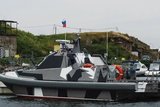
VICTA continues to take shape in the UK
The diver delivery system is on course to become operational late next year, says manufacturer SubSea Craft


UK-based advanced maritime technology business SubSea Craft has revealed new images of construction progress on its VICTA diver delivery system as it enters the final build phase.
CEO Scott Verney said: ‘We are on track for trials and testing this coming winter, with the aim of having the craft operational late 2021.’
The craft is made of carbon fibre with a Diab core: a lightweight construction many times stronger than fibreglass, according to SubSea Craft.
As a result, the company stated on 5 October, ‘VICTA will be faster and more manoeuvrable than comparable craft’.
VICTA can deploy and recover up to eight operatives (two crew and six divers). Powered by a submarinised SeaTek 725hp diesel engine, it can achieve surface speeds of up to 40kt over a range of 250nm. The engine is being tested at a SubSea Craft facility.
For underwater operations, the diver delivery system uses two SubCtech lithium-ion battery packs. These batteries generate sufficient energy to power the submersible for up to four hours (or a distance of 25nm) with two crew and six operators.
After the diesel engine is installed on VICTA, SubSea Craft will integrate C2 systems and an obstacle avoidance radar that generates a 3D picture of the sea floor out to 600m and down to 100m.
In a final stage before sea trials and testing, acrylic windows, hatches, hinges and the life-support system will be installed.
SubSea Craft has £12 million ($15.5 million) of private investment but it is now seeking second-stage investment.
As part of our promise to deliver comprehensive coverage to our Defence Insight and Premium News subscribers, our curated defence news content provides the latest industry updates, contract awards and programme milestones.
Related Equipment in Defence Insight

You may also like
More from Naval Warfare
-
![Can the US Navy ask Indo-Pacific allies to do more while training with them less?]()
Can the US Navy ask Indo-Pacific allies to do more while training with them less?
As the Iran War draws US ships and marine corps units away from the Indo-Pacific, curtailed exercises and a temporary carrier gap are exposing tensions between Washington’s demand for more self-reliant allies and the joint training needed to realise that ambition.
-
![How could Rheinmetall’s GMF 140 fit with ongoing programmes in North America?]()
How could Rheinmetall’s GMF 140 fit with ongoing programmes in North America?
With Canada committed to its River-class replacement and the USN pursuing a lower-cost frigate, Rheinmetall will need to demonstrate where the GMF 140 can fill a capability gap in the North American fleet.
-
![Australian industry programme builds pipeline for Virginia-class sustainment]()
Australian industry programme builds pipeline for Virginia-class sustainment
Australian businesses can now bid to support Virginia-class submarine sustainment in Western Australia, as momentum around the Henderson Defence Precinct also builds.
-
![South Korea, Japan and Turkey vie for US shipbuilding access in future frigate contest]()
South Korea, Japan and Turkey vie for US shipbuilding access in future frigate contest
Washington’s search for a foreign-built frigate could hand South Korea, Japan and Turkey a larger prize than a double-hull order: a foothold inside the US shipbuilding industrial base.
-
![Japan’s FY2027 budget bets on stand-off systems to offset demographic decline]()
Japan’s FY2027 budget bets on stand-off systems to offset demographic decline
Japan’s FY2027 defence budget backs stand-off strike, a 17-aircraft MQ-9B buy and a declared bid to lead the world in uncrewed maritime assets, alongside new frigates, submarines and support ships.
-
![Russia’s uncrewed boat portfolio hints at future naval demand]()
Russia’s uncrewed boat portfolio hints at future naval demand
Ukrainian intelligence has catalogued more than 20 Russian uncrewed surface vessels, revealing a portfolio weighted towards mine warfare and logistics, with implications for Western naval investment.