US Coast Guard pursues solutions to increase maritime domain dominance
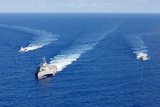
Cutter Campbell conducts small boat operations in the Windward Passage. (Photo: US Coast Guard)
The USCG is seeking technologies, services and applications to better connect its assets and speed up the decision-making process.


The US Coast Guard (USCG) is conducting market research to identify real-time, networked, unified technologies, services and applications capable of increasing naval predictive awareness while accelerating the decision-making process.
The capabilities should support the construction of a “detect-to-act” pipeline connecting the branch’s aerial and naval fleet, its inventory of uncrewed systems and its space, air, surface and shore-based sensors.
“The Coast Guard is not looking for a singular solution to provide the MDD [maritime domain dominance] capability, but rather a holistic and/or collection of capabilities to achieve this desired outcome,” the service stated in a request for information (RfI) published
Already have an account? Log in
Want to keep reading this article?


More from Naval Warfare
-
![NATO tests use of “undetectable, jam-proof” laser communication in maritime scenarios]()
NATO tests use of “undetectable, jam-proof” laser communication in maritime scenarios
As part of its effort to better prepare its capabilities for operations in contested and congested scenarios, NATO evaluated a Lithuanian ship-to-ship terminal designed to not be susceptible to enemy interference.
-
![US Navy advances with the Harpoon Service Life Extension Programme]()
US Navy advances with the Harpoon Service Life Extension Programme
The US Navy plans to improve Harpoon’s anti-ship and land attack capabilities by equipping the missiles with sensors and technologies required for succeeding in future battlespace.
-
![Future of the Canadian Patrol Submarine Project is still unclear]()
Future of the Canadian Patrol Submarine Project is still unclear
The Canadian government remains tight-lipped on the timeline and funding required for the next steps of its Canadian Submarine Patrol Project, which should offer improved capabilities for the country’s navy.