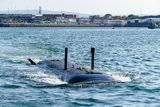
U212 NFS continues progress with design review milestone for battery system
Computer-generated image of U212 NFS submarine showing storage area for lithium-ion battery system (in yellow). (Image: OCCAR)
Passing the system design review for the lithium-ion battery system marks a step towards the potential production of up to four new submarines for the Italian Navy.


The lithium-ion (Li-ion) battery system for the Italian Navy U212 Near Future Submarine (NFS) programme has successfully passed the system design review (SDR) stage, OCCAR announced on 16 March.
It added: ‘This milestone marks a mandatory step forward in the development, possible production and integration on board of the U212 NFS fleet.’
The OCCAR U212 NFS Programme Division, submarine manufacturer Fincantieri and representatives from the Italian Navy cooperated in the SDR process.
With the SDR completed, the next stage is the critical design review to assess whether the design of the Li-ion energy storage system meets the operational requirements of the Italian Navy.
In February 2021, Fincantieri and OCCAR signed a €1.35 billion ($1.63 billion) contract to build two U212NFS diesel-electric submarines (plus two more boats on option) with deliveries scheduled for late 2027 and early 2029.
Related Programmes in Defence Insight
U-212 Near Future Submarine (4) [Italy]
U-212 Near Future Submarine (1-2) [Italy]
Related Equipment in Defence Insight

More from Naval Warfare
-
![Five years on: where could opportunities emerge next for AUKUS Pillar II?]()
Five years on: where could opportunities emerge next for AUKUS Pillar II?
Payload commonality, combat systems and electronic warfare are emerging as likely priorities as the trilateral partnership balances building submarines with sharing industrial ecosystems.
-
![Singapore expands maritime presence with future-ready Sentinel OPV]()
Singapore expands maritime presence with future-ready Sentinel OPV
Singapore is building space for uncrewed systems and future technologies into its new Sentinel-class OPVs, reflecting a wider move towards adaptable vessels capable of maintaining persistent maritime presence.
-
![From the Baltic to the Gulf: where USV procurement is heading next]()
From the Baltic to the Gulf: where USV procurement is heading next
Saildrone’s new Copenhagen base is one sign of a larger shift, as navies globally turn to uncrewed vessels for surveillance and mine clearance.
-
![Israeli Navy looks to expand as war reshapes future force requirements]()
Israeli Navy looks to expand as war reshapes future force requirements
Israel’s navy is preparing for a larger and more technically diverse role, but its ambitions could be impacted by supply chain restrictions, accelerating demand for domestic naval production as well as autonomous maritime capabilities.
-
![Quantum sensing gathers pace as navies eye undersea advantage]()
Quantum sensing gathers pace as navies eye undersea advantage
As AI dominates defence conversations, industry increasingly points to quantum sensing as the technology set to change submarine and uncrewed underwater vehicle operations.