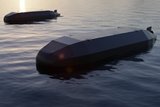
Sweden looks to Saab to extend life of its minehunters
A Koster-class MCMV pictured on the crane at the Saab Kockums shipyard in Karlskrona. (Photo: Saab)
Mine warfare is a crucial capability in the region, given the vast amount of unexploded ordnance in the Baltic Sea.


The Swedish Defence Material Administration (FMV) has contracted Saab for the life extension of two Koster-class mine countermeasures ships.
The agreement, worth SEK 350 million ($33.7 million), also includes options relating to the three-remaining ships of the class totalling SEK 270 million.
Modernisation work under the life extension contract covers exchanging systems and enhancing capabilities such as installing a new navigation radar and improving the combat system and surface sensors.
Saab Kockums head Lars Tossman said: ‘The mine countermeasure ships are an important capability for Sweden and for the protection of the Baltic Sea.
‘The contract means that the ships’ continued availability is ensured and is a testament to Saab’s competence to modify and develop capabilities on existing platforms.’
The Koster-class MCMVs were initially designated as the Landsort-class, but as five of the seven ships went through MLUs in 2009, it was renamed.
During the MLU, the ships were equipped with underwater RCVs.
According to Shephard Defence Insight, the ships have a displacement of 400t and can achieve a maximum speed of 15kts.
Related Equipment in Defence Insight


More from Naval Warfare
-
![RTX confirms US Marine Corps and US Navy acquire Hadalus UUV]()
RTX confirms US Marine Corps and US Navy acquire Hadalus UUV
RTX told Shephard that the Hadalus UUV has been procured by the US Marine Corps and the Office of Naval Research for operational experimentation as the company prepares additional demonstrations with the US Navy, NATO and AUKUS partners.
-
![Europe’s naval contractors benefit from growing refit and upgrade demand]()
Europe’s naval contractors benefit from growing refit and upgrade demand
Rheinmetall’s order to modernise the German Navy frigate Bayern points to a wider European shift towards extending warship service life as new-build programmes face delay.
-
![The UK joins the movement towards joint procurement]()
The UK joins the movement towards joint procurement
The UK will spend an estimated US$3.89 billion over the next decade in joint naval programmes, a lot of which will be in cooperation with Norway.