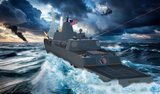
Rheinmetall to develop prototype naval airburst munition
The new MK 340 Kinetic Energy Electronically Timed is derived from the 30mm x 173 Kinetic Energy Timed Fuze cartridge. (Photo: Rheinmetall)
Rheinmetall claims that its new 30mm x 173mm Kinetic Energy Electronically Timed airburst round would aid point defence for surface vessels.


Rheinmetall on 30 June revealed a ‘considerable’ order from the USN for new medium-calibre ammunition, after US-based American Rheinmetall Munitions obtained a $14.3 million Other Transaction Agreement to develop a prototype 30mm x 173mm airburst round.
The aim is to create a ‘low-cost engagement capability that increases the effectiveness of existing and future naval gun weapon systems against air and surface threats’, Rheinmetall noted in a statement.
It hopes that the new prototype system will lead to IOC for the 30mm x 173mm MK 340 MOD 0 Kinetic Energy Electronically Timed (KEET) airburst munition.
The MK 340 KEET is derived from the NATO-qualified Rheinmetall 30mm x 173mm Kinetic Energy Timed Fuze cartridge currently fielded by the Australian, German, and Hungarian militaries.
Rheinmetall claimed that the new system ‘will provide significant lethality improvements and a reduction in rounds fired due to the increased first-round hit probability’.



More from Naval Warfare
-
![Funding for the future US Navy Trump-class battleship sparks controversy in Congress]()
Funding for the future US Navy Trump-class battleship sparks controversy in Congress
Lawmakers question the US Navy’s proposed $2 billion investment in the Trump-class battleship as concerns over cost, technology maturity and operational relevance fuel growing bipartisan scrutiny on Capitol Hill.
-
![UK’s Type 31 frigate balances cost pressure with long-term export ambition]()
UK’s Type 31 frigate balances cost pressure with long-term export ambition
The UK shipbuilder’s full-year results to the end of March revealed the impact of the £140 million charge linked to design changes and rework on the Royal Navy’s Type 31 frigate programme.
-
![Eurosatory 2026: Schiebel’s frigate-first strategy indicates a shift in UAV competition]()
Eurosatory 2026: Schiebel’s frigate-first strategy indicates a shift in UAV competition
Schiebel is pursuing opportunities in the UK and France while leveraging its integration with Naval Group’s FDI frigate programme to create new naval business across Europe.