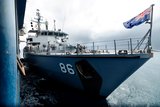
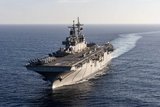
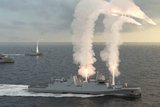
McKean supports USN Future Surface Combatant
McKean Defense leads team to provide hull, electrical, mechanical and other services for Future Surface Combatant.


Hull, mechanical and electrical controls in the USN Future Surface Combatant programme will be supported by a team led by McKean Defense Group, under a $20.1 million contract from Naval Surface Warfare Center Philadelphia Division (NSWCPD).
The five-year deal, announced by McKean Defense on 16 March, covers machinery, electric plant, propulsion, auxiliary, damage control, and ship control system programmes.
Work also includes navigation, interior communications domain networks, condition based monitoring, voyage data recorders, and digital video surveillance system engineering.
Joseph Carlini, CEO of McKean Defense, said the company has assembled a team ‘ready to support the complex Future Surface Combatant design solutions’ which are essential for the future US programme.
Potential solutions for Future Surface Combatant include large or medium-sized USVs.
As part of our promise to deliver comprehensive coverage to our Defence Insight and Premium News subscribers, our curated defence news content provides the latest industry updates, contract awards and programme milestones.


More from Naval Warfare
-
![Quantum Systems enters maritime domain with Baltic-focused USV and UUV]()
Quantum Systems enters maritime domain with Baltic-focused USV and UUV
Quantum Systems has launched into the maritime domain with Seavex and Subvex, aiming to close a Baltic Sea ISR gap opened by infrastructure sabotage.
-
![Suppliers await next step in Australia’s mine warfare transition]()
Suppliers await next step in Australia’s mine warfare transition
Australia’s mine countermeasure capability remains in flux as the Huon-class nears retirement, but accelerated investment in autonomous systems is opening a path for industry.
-
![Can the US Navy ask Indo-Pacific allies to do more while training with them less?]()
Can the US Navy ask Indo-Pacific allies to do more while training with them less?
As the Iran War draws US ships and marine corps units away from the Indo-Pacific, curtailed exercises and a temporary carrier gap are exposing tensions between Washington’s demand for more self-reliant allies and the joint training needed to realise that ambition.
-
![How could Rheinmetall’s GMF 140 fit with ongoing programmes in North America?]()
How could Rheinmetall’s GMF 140 fit with ongoing programmes in North America?
With Canada committed to its River-class replacement and the USN pursuing a lower-cost frigate, Rheinmetall will need to demonstrate where the GMF 140 can fill a capability gap in the North American fleet.
-
![Australian industry programme builds pipeline for Virginia-class sustainment]()
Australian industry programme builds pipeline for Virginia-class sustainment
Australian businesses can now bid to support Virginia-class submarine sustainment in Western Australia, as momentum around the Henderson Defence Precinct also builds.