Industry agreements point to growing interest in Danish hybrid fleet concept
The Royal Danish Navy frigate HDMS Iver Huitfeldt. The class’s proven hull design has become the basis for Babcock’s Arrowhead 140 frigate, now under consideration for Denmark’s future frigate requirement. (Photo: Royal Danish Navy)
Babcock’s new Danish industry agreements have reignited debate over whether Copenhagen is edging towards a hybrid fleet blending crewed frigates with autonomous systems.


Babcock has signed Memorandum of Understanding (MoU) with three Danish technology companies in a move that has sharpened questions over whether Denmark is preparing to build a hybrid navy combining crewed warships with autonomous systems.
The agreements, signed at DALO Industry Days, cover Stormborn and CUBEDIN, two Danish companies, and SH Group. The MOUs are intended to examine future hybrid naval capabilities and how crewed and uncrewed systems could operate together in a coordinated Danish fleet.
Sir Nick Hine, chief growth officer at Babcock, said the Arrowhead 140 illustrated the depth of the relationship, describing it as an example of the
Our news & analysis is now part of Defence Insight®
A Basic-level or higher Defence Insight subscription is now required to view this content.

More from Naval Warfare
-
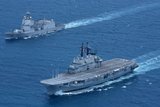
![Industrial teams prepare roadmap for Indonesia aircraft carrier transformation]()
Industrial teams prepare roadmap for Indonesia aircraft carrier transformation
Fincantieri and PT PAL have agreed on a framework to modernise the former Giuseppe Garibaldi, with drones, communications and broader Italian–Indonesian industrial ties involved.
-
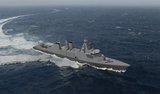
![Denmark’s air defence frigate requirement draws growing European competition]()
Denmark’s air defence frigate requirement draws growing European competition
With no formal competition under way, industrial partnerships, production capacity and air defence capability could all shape the programme as Denmark considers how to replace its three Iver Huitfeldt-class frigates.
-
![Five years on: where could opportunities emerge next for AUKUS Pillar II?]()
Five years on: where could opportunities emerge next for AUKUS Pillar II?
Payload commonality, combat systems and electronic warfare are emerging as likely priorities as the trilateral partnership balances building submarines with sharing industrial ecosystems.
-
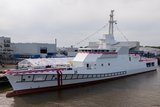
![Singapore expands maritime presence with future-ready Sentinel OPV]()
Singapore expands maritime presence with future-ready Sentinel OPV
Singapore is building space for uncrewed systems and future technologies into its new Sentinel-class OPVs, reflecting a wider move towards adaptable vessels capable of maintaining persistent maritime presence.