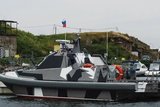
Indian Navy’s DSRV in new testing


JFD has completed sea trials of the Deep Search and Rescue Vehicle (DSRV) being delivered to the Indian Navy.
The DSRV carried out underwater mating with a submarine at a depth of over 300ft, followed by a target mating and hatch opening at 45 degrees. On successful mating with the submarine, personnel were safely transferred from the submarine to the DSRV.
Designed to facilitate the rescue of personnel from a disabled submarine at sea, the DSRV already successfully completed harbour trials, and has now replicated all operating conditions of a real submarine rescue operation.
JFD is delivering two complete third-generation submarine rescue systems to the navy under a £193 million contract. The system includes launch and recovery systems equipment, transfer under pressure systems, logistics and support equipment, and a 25-year all inclusive annual maintenance contract.
Ben Sharples, India DSRV project director, said: ‘The Indian Navy west coast-based rescue team, who will operate the system when in service, were active participants throughout this phase of the trials, ensuring they are equipped with the skills and expertise to conduct safe and efficient submarine rescue operations, should the need ever arise.
‘The sea trials of the DSRV has ushered in a niche capability into the Indian Navy. The DSRV, which is operated by a crew of three, can rescue 14 personnel from a disabled submarine at one time. These sea trials have proven the newly inducted DSRV’s ability to undertake rescue operations from disabled submarines at sea and has provided the Indian Navy with a critical capability.’

More from Naval Warfare
-
![Can the US Navy ask Indo-Pacific allies to do more while training with them less?]()
Can the US Navy ask Indo-Pacific allies to do more while training with them less?
As the Iran War draws US ships and marine corps units away from the Indo-Pacific, curtailed exercises and a temporary carrier gap are exposing tensions between Washington’s demand for more self-reliant allies and the joint training needed to realise that ambition.
-
![How could Rheinmetall’s GMF 140 fit with ongoing programmes in North America?]()
How could Rheinmetall’s GMF 140 fit with ongoing programmes in North America?
With Canada committed to its River-class replacement and the USN pursuing a lower-cost frigate, Rheinmetall will need to demonstrate where the GMF 140 can fill a capability gap in the North American fleet.
-
![Australian industry programme builds pipeline for Virginia-class sustainment]()
Australian industry programme builds pipeline for Virginia-class sustainment
Australian businesses can now bid to support Virginia-class submarine sustainment in Western Australia, as momentum around the Henderson Defence Precinct also builds.
-
![South Korea, Japan and Turkey vie for US shipbuilding access in future frigate contest]()
South Korea, Japan and Turkey vie for US shipbuilding access in future frigate contest
Washington’s search for a foreign-built frigate could hand South Korea, Japan and Turkey a larger prize than a double-hull order: a foothold inside the US shipbuilding industrial base.
-
![Japan’s FY2027 budget bets on stand-off systems to offset demographic decline]()
Japan’s FY2027 budget bets on stand-off systems to offset demographic decline
Japan’s FY2027 defence budget backs stand-off strike, a 17-aircraft MQ-9B buy and a declared bid to lead the world in uncrewed maritime assets, alongside new frigates, submarines and support ships.
-
![Russia’s uncrewed boat portfolio hints at future naval demand]()
Russia’s uncrewed boat portfolio hints at future naval demand
Ukrainian intelligence has catalogued more than 20 Russian uncrewed surface vessels, revealing a portfolio weighted towards mine warfare and logistics, with implications for Western naval investment.