How the Hedge Strategy will impact the US Navy’s future capabilities
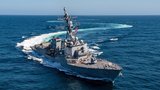
Blueprint of the Constellation-class guided-missile frigates. (Photo: US Department of Defense)
The US Navy Hedge Strategy is intended to provide a lethal, modular and cost-effective fleet while accepting Washington’s fiscal and industrial constraints.


The US Navy (USN) will adopt a more realistic approach to conduct its development and procurement programmes as part of its recently announced Hedge Strategy, which focuses on lethality, adaptability and affordability.
The policy prioritises the acquisition of cost-effective, flexible, modular, multidomain capabilities in a schedule that aligns with Washington’s financial and defence manufacturing capacities.
It aims to address the multiple delays and cost overruns that have been recorded in several acquisition programmes, with a Congressional Research Service report published on 20 January – titled Navy Force Structure and Shipbuilding Plans – revealing that the service’s main shipbuilding efforts are currently between one and three
Already have an account? Log in
Want to keep reading this article?



More from Naval Warfare
-
![US Navy SPY-6 approaches FRP with Raytheon already having “a hot production line”]()
US Navy SPY-6 approaches FRP with Raytheon already having “a hot production line”
Jen Gauthier, Raytheon’s VP of Naval Systems and Sustainment, told Shephard that the company is awaiting the US Navy’s green light to move “fully into full-rate production”.
-
![Ireland releases maritime strategy as it looks to new naval bases and stronger partnerships]()
Ireland releases maritime strategy as it looks to new naval bases and stronger partnerships
Ireland has a maritime area ten times the size of its land mass but has a limited naval capacity and faces an ongoing threat to critical underwater infrastructure. A new strategy is looking to address the challenge.
-
![How the Golden Fleet will change the US Navy acquisition process]()
How the Golden Fleet will change the US Navy acquisition process
The procurement of the future USN Golden Fleet is planned to be less bureaucratic than previous strategies, involving AI-enabled designs and scheduling tools to increase productivity and avoid delays.
-
![What capabilities are being tested under AUKUS Pillar II?]()
What capabilities are being tested under AUKUS Pillar II?
Collaboration on AUKUS Pillar II extends beyond the core trilateral agreement, presenting global opportunities for companies with advanced technologies.