Greece seeks engine support for HS Toxotis
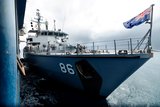
HS Toxotis is a fast patrol boat in service with the Hellenic Navy. (Photo: Hellenic Navy)
The Hellenic Navy requires a contractor to maintain and sustain the two engines powering an ex-Norwegian patrol boat.


The Hellenic Navy has opened a tender for maintenance and sustainment of the two MTU 12V-331 engines that power the fast patrol boat HS Toxotis.
A two-year contract will be worth almost €217,000 ($246,600). Responses are due by 14 March.
Toxotis was originally built in the 1960s for the Royal Norwegian Navy as a Tjeld-class boat. It was sold to the Hellenic Navy in 1981.
The 24.5m-long boat displaces 72t, has a top speed of 21.5kt and is armed with one Bofors L70 40mm and a single Oerlikon 20mm cannon.

You may also like
More from Naval Warfare
-
![Competitive P17B tender marks a shift in Indian Navy frigate procurement]()
Competitive P17B tender marks a shift in Indian Navy frigate procurement
The Indian Navy's P17B programme is expected to combine greater weapons capacity with a competitive domestic construction model, although key systems could remain dependent on international supply chains.
-
![How France’s SNLE 3G programme is reshaping the naval nuclear industrial base]()
How France’s SNLE 3G programme is reshaping the naval nuclear industrial base
Extending far beyond a four-submarine replacement programme, France’s ballistic missile submarine effort is a decades-long industrial initiative designed to preserve the country’s ability to build and sustain nuclear-powered strategic platforms.
-
![Quantum Systems enters maritime domain with Baltic-focused USV and UUV]()
Quantum Systems enters maritime domain with Baltic-focused USV and UUV
Quantum Systems has launched into the maritime domain with Seavex and Subvex, aiming to close a Baltic Sea ISR gap opened by infrastructure sabotage.
-
![Can the US Navy ask Indo-Pacific allies to do more while training with them less?]()
Can the US Navy ask Indo-Pacific allies to do more while training with them less?
As the Iran War draws US ships and marine corps units away from the Indo-Pacific, curtailed exercises and a temporary carrier gap are exposing tensions between Washington’s demand for more self-reliant allies and the joint training needed to realise that ambition.