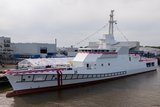
Fincantieri launches Italian Navy LHD
Fincantieri has launched the Italian Navy’s newest Landing Helicopter Dock (LHD), Trieste, at its shipyard in Castellammare di Stabia, the company announced on 25 May.The vessel will be delivered in 2022.
The multirole and multipurpose amphibious vessel has a length of approximately 214m with a maximum speed of 25 knots. It is capable of deploying aircraft and amphibious vehicles and equipment via a 230m flight deck and a floodable basin located on the stern of the ship.
The vessel will be equipped with a Combined Diesel Electric Or Gas propulsion system and an additional electric propulsion system to be used for low speed sailing, in line with the Italian Navy’s environmental policy.
In addition to transporting vehicles, personnel and equipment, drinking water, power supply, healthcare and medical support, the LHD is designed to carry out command and control functions in case of emergencies at sea, evacuation of nationals and humanitarian assistance operations.
With over 1,000 sleeping accommodations, the new vessel will be capable of supporting operations of a battalion consisting of 600 personnel, with a dock-garage capable of accommodating 1,200 linear metres of wheeled and tracked vehicles, both civilian and military. A fully equipped hospital will also be available onboard, complete with
operating rooms, radiology and analysis rooms, a dentist’s office, and patient rooms capable of hosting 27 seriously injured patients.
The floodable dock – 50m long and 15m wide - will enable the ship to deploy the most technically advanced amphibious equipment and vehicles of EU and NATO navies.
Related Equipment in Defence Insight


More from Naval Warfare
-
![Five years on: where could opportunities emerge next for AUKUS Pillar II?]()
Five years on: where could opportunities emerge next for AUKUS Pillar II?
Payload commonality, combat systems and electronic warfare are emerging as likely priorities as the trilateral partnership balances building submarines with sharing industrial ecosystems.
-
![Singapore expands maritime presence with future-ready Sentinel OPV]()
Singapore expands maritime presence with future-ready Sentinel OPV
Singapore is building space for uncrewed systems and future technologies into its new Sentinel-class OPVs, reflecting a wider move towards adaptable vessels capable of maintaining persistent maritime presence.
-
![From the Baltic to the Gulf: where USV procurement is heading next]()
From the Baltic to the Gulf: where USV procurement is heading next
Saildrone’s new Copenhagen base is one sign of a larger shift, as navies globally turn to uncrewed vessels for surveillance and mine clearance.
-
![Israeli Navy looks to expand as war reshapes future force requirements]()
Israeli Navy looks to expand as war reshapes future force requirements
Israel’s navy is preparing for a larger and more technically diverse role, but its ambitions could be impacted by supply chain restrictions, accelerating demand for domestic naval production as well as autonomous maritime capabilities.
-
![Quantum sensing gathers pace as navies eye undersea advantage]()
Quantum sensing gathers pace as navies eye undersea advantage
As AI dominates defence conversations, industry increasingly points to quantum sensing as the technology set to change submarine and uncrewed underwater vehicle operations.