Exercise Freezing Winds brings navies together to ease Finland into NATO
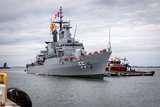
HMS Iron Duke, part of the Royal Navy contingent on Exercise Freezing Winds. (Photo: Royal Navy/Crown copyright)
The nine-day exercise off the Finnish coast was intended to boost interoperability in challenging weather conditions.


Almost 30 naval vessels from 15 countries took part in one of NATO’s most challenging training exercises, Exercise Freezing Winds, in the Baltic Sea between 20–29 November.
The exercise, which involved almost 4,000 sailors and air crew, took place off the coast of Finland and was partially geared towards driving Finland’s integration into NATO and its exercises.
Scenarios simulated during the nine-day exercise included multi-domain naval and amphibious operations, maritime security operations and protection of critical undersea infrastructure.
Related Articles
New Swedish signal intelligence ship goes to sea amid Baltic tensions
Germany and Finland suspect “hybrid sabotage” of undersea infrastructure
The last of those was a particularly timely element of the training, as November saw two undersea cables in the Baltic severed by an impact which as yet remains mysterious, but which the governments of both Germany and Finland – both nations affected by the cable cutting – have said “looked like hybrid sabotage”.
Subsequent discussions among Baltic coast nations have called for particular, potentially sub-NATO “maritime policing” of the Baltic Sea, because of the threat they perceive is posed by Russia in the region.
Cdr Beata Król, Commander of Standing NATO Maritime Group 1 (SNMCMG1), which provided many of the vessels involved, said Exercise Freezing Winds improved interoperability between sailors of different navies.
“In order to conduct joint maritime operations swiftly and effectively, interoperability is the key to success. Exercise Freezing Winds provides us with the opportunity to train the procedures with our partners in a multi-layered scenario,” she said.
Finland navy chief of staff Cdre Janne Huusko added: “As Finland’s integration into NATO deepens, Exercise Freezing Winds becomes an important part of NATO’s actions in the Baltic Sea. Freedom of movement in the Baltic Sea area is vital to all actors and stakeholders around [the] Baltic Sea.”
The UK’s Royal Navy sent Type 23 Duke-class frigate HMS Iron Duke to take part in Exercise Freezing Winds, shortly after it acted as part of the monitoring fleet as Russian vessels, particularly the Project 22350 frigate Admiral Golovko, conducted exercises in the English Channel.
Related Equipment in Defence Insight

More from Naval Warfare
-
![Ukraine war drives ‘minimum deployable capability’ doctrine in uncrewed systems development]()
Ukraine war drives ‘minimum deployable capability’ doctrine in uncrewed systems development
Ukraine’s battlefield has rewritten the rules of uncrewed systems development. For Syos Aerospace, real-time operator feedback, lean serial production and a system-of-systems philosophy are central to its operating model.
-
![AUKUS advance on UUVs contrasts with Virginia-class compromise]()
AUKUS advance on UUVs contrasts with Virginia-class compromise
The AUKUS partnership is accelerating uncrewed undersea capability while its submarine arm inches forward, and Australia’s decision to settle for three in-service Virginia-class boats raises questions about industrial risk, dependency and whether Pillar II may deliver meaningful capability long before Pillar I can.
-
![AUKUS plan B? Japan’s submarines stopgap gains traction]()
AUKUS plan B? Japan’s submarines stopgap gains traction
Australia’s Collins-class life of type extension has revived debate over whether Canberra needs a contingency plan as risks to every stage of the AUKUS pathway mount. With Japan newly open to exports, the case for a diesel-electric stopgap is gaining traction.
-
![Seoul’s SSN programme launch raises questions on fuel, tech and build location]()
Seoul’s SSN programme launch raises questions on fuel, tech and build location
Seoul has unveiled its “Jangbogo-N Project” to develop domestically built, nuclear-propelled attack submarines in close coordination with Washington, marking an escalation of the Republic of Korea’s deterrence posture against Pyongyang’s undersea nuclear capabilities.