Euronaval: Thales launches maritime security solution


Thales has developed a new waterway protection system called SeeMapper. The company introduced the system, designed protect waterways such as shipping lanes and port access channels against maritime threats, at Euronaval on 27 October.
Thales has developed SeeMapper – a self-contained solution that provides continuous, high-resolution mapping of the sea-bed – in response to rising demand from defence forces, maritime security agencies and private operators for systems capable of tackling maritime threats such as sea mines and acts of piracy.
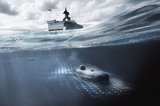
The system provides mapping via a towed synthetic aperture sonar (T-SAS) deployed by a service vessel, to assist maritime authorities in the detection, classification and location of objects below the surface in areas such as shipping lanes, straits, maritime approaches, port access channels, and naval bases. It enables them to conduct regular surveillance in their areas of responsibility at all times.
SeeMapper comprises a vessel deploying a real-time imagery chain to maintain continuous surveillance of the underwater environment, with a T-SAS performing high-quality mapping of the sea-bed. The vessel is also equipped with a fully automatic system to launch and recover the towed sonar. A command-and-control system is used for mission planning and management and to automatically analyse the data gathered.
Privately operated underwater installations such as offshore platforms, oil & gas installations, wind farms, and marine turbines can also deploy the system to monitor underwater installations to check that systems are operating correctly and to carry out maintenance.
The system has been qualified for operation in rough sea states, and requires only minimal training and no specialised skills for launching and recovering the towed sonar array.

More from Naval Warfare
-
![Competitive P17B tender marks a shift in Indian Navy frigate procurement]()
Competitive P17B tender marks a shift in Indian Navy frigate procurement
The Indian Navy's P17B programme is expected to combine greater weapons capacity with a competitive domestic construction model, although key systems could remain dependent on international supply chains.
-
![How France’s SNLE 3G programme is reshaping the naval nuclear industrial base]()
How France’s SNLE 3G programme is reshaping the naval nuclear industrial base
Extending far beyond a four-submarine replacement programme, France’s ballistic missile submarine effort is a decades-long industrial initiative designed to preserve the country’s ability to build and sustain nuclear-powered strategic platforms.
-
![Suppliers await next step in Australia’s mine warfare transition]()
Suppliers await next step in Australia’s mine warfare transition
Australia’s mine countermeasure capability remains in flux as the Huon-class nears retirement, but accelerated investment in autonomous systems is opening a path for industry.
-
![Can the US Navy ask Indo-Pacific allies to do more while training with them less?]()
Can the US Navy ask Indo-Pacific allies to do more while training with them less?
As the Iran War draws US ships and marine corps units away from the Indo-Pacific, curtailed exercises and a temporary carrier gap are exposing tensions between Washington’s demand for more self-reliant allies and the joint training needed to realise that ambition.