Integrated approach: transforming vehicle communications for a new era of warfare
In the modern battlespace, military intercom systems can no longer operate in isolation. They must instead be integrated with the wider tactical network, gaining operational advantages through secure communications with dismounted soliders and other assets across domains.


Brought to you in partnership with Bittium
Traditionally, vehicle intercom systems functioned as closed analogue loops, essentially isolated from the wider operational picture. However, this approach is no longer fit for purpose, according to Sami Pesonen, product manager at tactical communications specialist Bittium. In multi-domain operations defined by data, vehicles are now critical nodes in a common network.
“They receive information from outside the vehicle – from sensors and other assets – and they deliver information to the outside world, all while communicating with mounted and dismounted personnel,” he explained.
It is crucial for militaries to embrace this transformation, noted Pesonen. The alternative is a “stovepiped” approach, with artificial boundaries slowing the transmission of information.
The technology used to connect vehicles to these wider networks must be simple to manage and adapt, he noted: “It should be built on a modular structure where you can easily add new sensors, cameras and other devices, without needing to renew the whole architecture in the vehicle; it should be ‘plug and play’.”
More than an intercom
The demands of this evolving communications environment drove the development of Bittium’s new MissionNet solution, Pesonen explained. MissionNet replaces isolated vehicle intercom systems with a fully networked architecture, integrating crew communications into the tactical battlefield IP network, connecting them with other users who may be mounted or dismounted, wired or wireless.
Officially launched at Eurosatory 2026, the core of the system is Bittium’s Tough VoIP, a distributed and resilient digital voice service. MissionNet is designed for mobile tactical environments and by ensuring that voice and data share a single IP infrastructure, a wide array of platforms and personnel can remain connected in real time, functioning within a single coherent network.
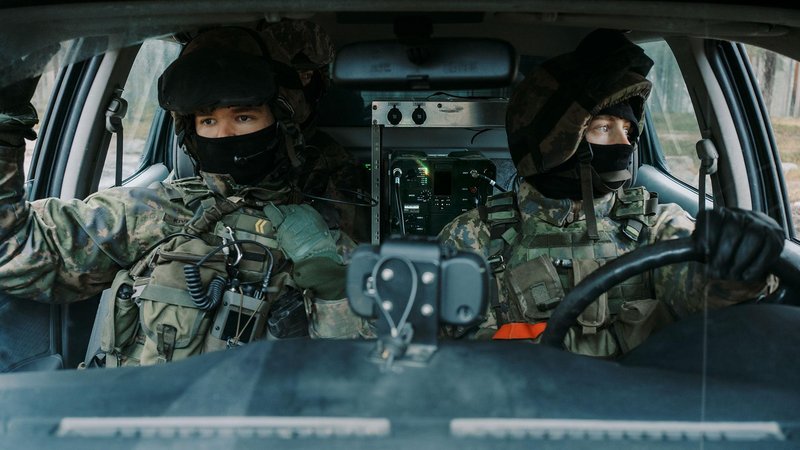
At the same time as it unveiled MissionNet, Bittium also launched its new Tough PTT device, a push-to-talk system that functions as a networked endpoint for both voice and data connectivity. Tough PTT provides a dual-purpose rugged node in a single device; voice and data are delivered over the same hardware and connectivity, while the system uses standard interfaces such as Ethernet, USB and Bluetooth.
Only two Tough PTT devices are needed to form a distributed voice network, without the need for additional infrastructure. The system provides a common architecture allowing different capabilities to work together through MissionNet and is designed to function across a range of devices, such as software-defined radios or COTS computers, explained Pesonen. “That’s the beauty of it – it doesn’t need any centralised server or device,” he said.
Adaptable and resilient
The technology has significant implications for troops on the ground. Because voice and data are brought together onto a common IP architecture, vehicle crews have enhanced capabilities to communicate and share information with the wider force.
“It turns the vehicle into one node in the network – it’s no longer an isolated platform,” Pesonen said.
Highlighting examples of the operational benefits of the technology, he noted that Tough PTT offers flexible connectivity for devices such as head-up displays, mission systems and headsets, enabling them to join the wider network and boosting communication and data-sharing capabilities. This means that dismounted soldiers in proximity to the vehicle can access the same network, sharing information and receiving transmissions.
Pesonen also highlighted the important of resilience. The Tough VoIP service can run on multiple devices, meaning that if one or more are damaged or lost, the network will remain intact. “There is no single point of failure,” he explained.
Focus on applications
While armed forces often use varying mixes of communications equipment, because MissionNet can be set up with just two Tough PTT devices, its networking capability can easily be delivered alongside existing systems as required.
There is a “a lot of horsepower under the hood” of Tough BTT, Pesonen added, enabling the system to support other devices and data needs as required in the future. “We have standard IP technologies and our interfaces are standard, so it’s easy to upgrade without the need to renew the whole system.”
Such devices – and the evolving nature of military vehicles in the battlespace – represent more than simply a technological transition, concluded Pesonen.
“The distinctions between intercoms, radios or other hardware become less important; it’s more about the services and applications that the network can provide.”
Find out more about MissionNET, Tough PTT and Bittium’s full range of battlefield network solutions


More from Studio
-
![Active protection systems: from optional upgrade to operational requirement]()
Active protection systems: from optional upgrade to operational requirement
As battlefield threats multiply, active protection systems are becoming increasingly important for armoured vehicle survivability – but cost, integration challenges and evolving drone threats will determine how widely they can be deployed.
-
![How laser weapons could transform the economics of European air defence (Podcast)]()
How laser weapons could transform the economics of European air defence (Podcast)
Former UK Defence Secretary Lord John Hutton examines how drones, missiles, laser weapons and procurement pressures are reshaping European air defence.
-
![How Pearson Engineering combines tradition with innovation for the demining mission (Video)]()
How Pearson Engineering combines tradition with innovation for the demining mission (Video)
At Eurosatory 2026, Pearson Engineering's Group CEO Ian Bell talked about the company's role in delivering specialist armoured engineering, route-clearance and demining capabilities to military customers around the world.
-
![Ukraine experience forces rethink of counter-UAS doctrine]()
Ukraine experience forces rethink of counter-UAS doctrine
A panel session at Eurosatory 2026 brought together industry, academia and the French armed forces to assess how Ukraine’s battlefield reality is reshaping counter-UAS (CUAS) technology, air defence doctrine and Western procurement priorities.
-
![Networked advantage: keeping unmanned systems in the loop with battlefield radio technology]()
Networked advantage: keeping unmanned systems in the loop with battlefield radio technology
Unmanned systems are powerful intelligence, surveillance and reconnaissance (ISR) assets and communication tools, but are often isolated from wider networks, limiting their potential. Industry is now tackling this challenge, empowering UxVs to act as integrated nodes across domains.
-
![Air defence at scale: Europe’s challenge of cost, integration and sustainability]()
Air defence at scale: Europe’s challenge of cost, integration and sustainability
The evolution of aerial threats is driving renewed investment in ground-based air defence across Europe. Yet beyond capability, a more pressing challenge is emerging: how to sustain air defence at scale, as rising costs, limited stockpiles and industrial production constraints place increasing pressure on existing structures.