Tactical connectivity built for contested environments
Modern tactical operations depend on resilient connectivity that can survive congestion, jamming, and rapidly evolving electronic warfare.


Enjoy free access to this sponsored article, all content provided by Creomagic
Communication breakdowns have become one of the primary drivers of mission disruption in modern warfare. As autonomous systems and tactical units increasingly dominate the battlefield, forces require continuous data, voice, and video exchange to maintain real-time synchronization, operational awareness, and mission effectiveness.
Recent conflicts have demonstrated that spectrum resilience is now as critical as kinetic capability. Yet, securing these mission-critical communications in heavily contested electromagnetic environments remains a major operational challenge.
To maintain tactical advantage in rapidly evolving operational environments, communication systems must be able to adapt quickly to changing mission requirements, emerging threats, and evolving spectrum conditions.
Software-defined radio (SDR) technology enables faster capability upgrades, operational flexibility, and reduced dependency on fixed hardware architectures or commercial wireless technologies originally designed for civilian environments.
By moving critical networking functions into software, tactical communication systems can evolve more rapidly, reduce integration complexity, and support new operational requirements without requiring continuous hardware redesign cycles.
Addressing these operational challenges, Creomagic delivers advanced cognitive SDR and dual-waveform tactical networking technology to maintain resilient communication in highly congested and electronically contested environments.
When the spectrum gets crowded, missions must continue
From a systems engineering perspective, mission success begins at the waveform level. Tactical units operating across complex terrain and congested spectrums require information to flow dynamically through the most reliable available paths while maintaining network integrity under electromagnetic stress.
Creomagic’s SDR technology, CreoNet, creates fully encrypted tactical networks while continuously analyzing the RF environment in real time. Using adaptive algorithms, the system identifies spectrum congestion, interference patterns, and potential jamming activity.
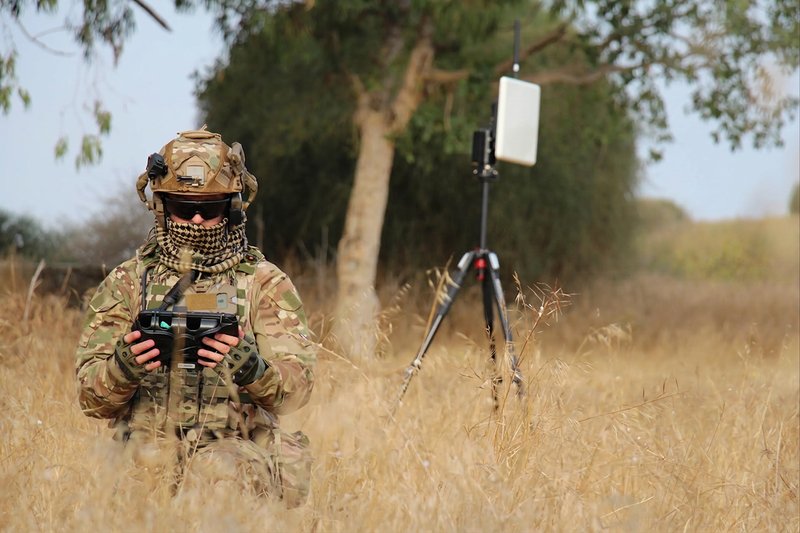
Without operator intervention, the system autonomously adjusts operational parameters, frequency selection, modulation techniques, and waveform behaviour in order to maintain connectivity and mission continuity.
By combining spectrum awareness with adaptive networking capabilities, the system supports resilient communications even under severe electronic warfare conditions.
Open-architecture design and integration-ready interfaces also support interoperability across a broad range of tactical platforms and operational environments.
The dual-waveform edge
At the core of Creomagic’s tactical networking capability is a dual-rate waveform designed to maintain operational continuity in contested environments. The technology enables simultaneous operation across two complementary waveform layers, effectively creating two synchronized tactical communication domains.
The primary layer is optimized for high-throughput, broadband communications, supporting applications such as real-time low-latency video streaming.
The secondary layer provides a highly resilient low-signature command-and-control channel designed to preserve critical communications during severe interference or jamming scenarios.
This simultaneous dual-waveform approach enables smooth make-before-break transitions while maintaining continuous tactical connectivity during severe RF disruptions. This helps reduce the traditional compromise between throughput and survivability while supporting Low Probability of Interception and Detection (LPI/LPD) operational requirements in unpredictable electromagnetic environments.
Supporting European operational requirements
Through CreoX Technology, Creomagic’s European operating entity, the company supports defence and security organizations with tactical communication solutions tailored to evolving European requirements..
The company continues to expand its integration and operational support activities across Europe, working closely with regional partners and customers operating in complex tactical environments.
This approach enhances operational flexibility, integration readiness, and supply-chain resilience for European defence and security programmes.
Meeting industry and military standards
Creomagic solutions are designed to meet industry and military standards, helping reduce integration and operational risk.

Creomagic communication solutions support ground, airborne, maritime, and personal tactical networks, including systems for UAVs, UGVs, robotic platforms, and dismounted forces.
Come and see us at ILA Berlin Air Show 2026. Creomagic will present its latest tactical communication and datalink technologies. Visit Hall D, Stand 225, to meet the team and learn more.

You may also like

More from Industry Spotlights
-
![Orchestrating operational readiness across every defence domain]()
Orchestrating operational readiness across every defence domain
Are all systems ready for the next mission? Have upgrades been applied? Are all assets aligned to deploy together, on time and fully prepared? In modern defence operations, readiness is no longer measured platform by platform. It is measured by how well people, assets, data and decisions move together — across land, sea and air.
-
![Extending mission readiness: where XR adds real value in pilot, crew and maintenance training]()
Extending mission readiness: where XR adds real value in pilot, crew and maintenance training
Extended reality (XR) is becoming increasingly relevant in military aviation training, adding a flexible layer to an integrated ecosystem spanning the pilot, crew, and maintenance domains.
-
![Dominating the spectrum: ASELSAN’s EW capabilities take center stage at MSPO 2026]()
Dominating the spectrum: ASELSAN’s EW capabilities take center stage at MSPO 2026
ASELSAN is showcasing its advanced electronic warfare (EW) capabilities at MSPO 2026, highlighting technologies designed to detect, analyse, disrupt and deceive threats across increasingly contested electromagnetic environments.
-
![“Creating a decision advantage”: how C-UAS is evolving to reduce the operator burden]()
“Creating a decision advantage”: how C-UAS is evolving to reduce the operator burden
In Conversation… Speaking to Shephard’s Gerrard Cowan, Dr Brian Shand, Director – Advanced Concepts & Technology at L3Harris, explains how, as operators face growing numbers of low-cost drones, C-UAS providers must focus on reducing operator workload, transforming fragmented sensor data into effective decision-making.
-
![Shield the warfighter, win the fight (video)]()
Shield the warfighter, win the fight (video)
BAE Systems’ Intrepid Shield™ approach delivers full-spectrum electromagnetic protection to detect, exploit, and counter advanced threats.
-
![How joint ventures are expanding Rheinmetall's munitions portfolio (video)]()
How joint ventures are expanding Rheinmetall's munitions portfolio (video)
Roman Köhne, CEO of Rheinmetall's Weapon and Ammunition Division, discusses the company's announcements at Eurosatory 2026, including developments in defence technology, precision systems, industrial partnerships and future capability programmes.