Second test firing of US Multi-Mission Launcher complete
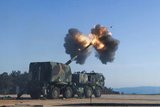
The US Army successfully completed the second test firing of the Multi-Mission Launcher (MML) using a Launch Demonstration Unit, as announced on 23 March.
Three missiles were launched from the demonstration unit, including an Air Intercept Missile 9-X that intercepted an unmanned aerial vehicle after launch. A Low Cost Active Seeker and a Mini Hit-to-Kill interceptor were also successfully launched and flew ballistic trajectories.
The test verified the tube integrity and missile stack integration of the MML. The army’s Indirect Fire Protection Capability Increment 2-Intercept (IFPC Inc 2-I) programme remains on schedule to conduct an engineering demonstration in March 2016.
The Aviation and Missile Research, Development and Engineering Center (AMRDEC) is designing and producing two launcher prototypes for integration into the IFPC Inc 2-I system during the technology maturation and risk reduction phase of development.
The MML is a next-generation air defence launcher built on open-system architecture. It has the capacity to launch various interceptors against unmanned and cruise missile threats. The army plans to field this launcher in 2019.
James Lackey, director, AMRDEC, said: ‘This, yet again, demonstrates a positive step forward for the MML.
‘MML will be critical in providing expanded ground troop area protection capabilities by enabling kinetic kill lethality effects against a variety of advanced, airborne incoming threats.’


More from Land Warfare
-
![Polaris expands Arctic mobility offering as US military orders grow]()
Polaris expands Arctic mobility offering as US military orders grow
The Military 850 Voyageur 155 Crossover has secured orders from the US Army, Air Force and Marine Corps, addressing demand for agile Arctic mobility with passenger, cargo and towing capacity.
-
![More bidders move onto starting grid for British Army Land Rover replacement programme]()
More bidders move onto starting grid for British Army Land Rover replacement programme
The Light Mobility Vehicle segment of the UK’s Land Mobility Programme for the British Army may actually be about to make progress, or at least likely bidders seem to think so. Shephard spoke with several contenders who revealed their views on how the army should replace the ageing fleet.
-
![Northrop Grumman pushing ahead with smaller Integrated Battle Command System]()
Northrop Grumman pushing ahead with smaller Integrated Battle Command System
Northrop Grumman’s Integrated Battle Command System is in service with Polish forces and is being introduced to US forces, with further development underway on the original platform as well as a smaller, more mobile system.
-
![UK’s ground-based air defence effort remains in assessment phase after third industry day]()
UK’s ground-based air defence effort remains in assessment phase after third industry day
The UK’s plan to introduce a new air defence capability into the British Army will cover short and medium-range defence as well as counter-uncrewed aerial system systems. Timelines are not yet laid out but industry is making plans.