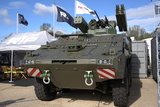
Rheinmetall to develop light artillery cannon for US Army
American Rheinmetall Munition aims to support future US lightweight howitzer and other armament technologies. (Photo: US Army/1st Lt Stephanie Snyder)
Information collected by American Rheinmetall Munition will feed into future US Army lightweight howitzer technologies.


The US Army has awarded a $2.5 million contract for American Rheinmetall Munition to develop and deliver a shorter and more lightweight artillery weapon system.
Parent company Rheinmetall said the lightweight artillery cannon would enhance the mobility, manoeuvrability and lethality of US Army artillery systems.
The company believes the new cannon will meet the long-range firing performance capability sought by the US.
The effort will support the US National Defense Strategy published in March and will also serve as an information collecting exercise for the US Army’s ongoing capability assessment for a next-generation armament.
‘We are proud to have the opportunity to support the Army in its efforts to develop next-generation long-range precision fires technologies and particularly to prototype what could be game-changing advanced, lightweight howitzer technologies,’ American Rheinmetall Munition CEO John Somich noted in a statement.
This year the DoD announced contract modifications twice for the production and delivery of M109A7 self-propelled howitzers and M992A3 tracked carrier ammunition vehicles.
Related Equipment in Defence Insight




More from Land Warfare
-
![September land forces roundup: DVD 2026 puts British Army requirements in the spotlight]()
September land forces roundup: DVD 2026 puts British Army requirements in the spotlight
The US Army began its search for a 155mm tracked mobile tactical cannon in an effort that Shephard forecasts could be worth billions of dollars. Meanwhile, the UK DVD exhibition saw companies showcase their offerings for the British Army’s mobility and air defence requirements.
-
![FNSS advances Indonesian Kaplan APC programme as local production expands]()
FNSS advances Indonesian Kaplan APC programme as local production expands
FNSS and PT Pindad are progressing the Indonesian tracked armoured personnel carrier programme as local production gets under way.
-
![British Army's open plan draws diverse offerings for Land Rover replacement]()
British Army's open plan draws diverse offerings for Land Rover replacement
The UK Ministry of Defence has avoided being prescriptive in its search to replace the British Army’s Land Rover, meaning vehicle types being offered range from Land Rover Defender Wolf II and Humvee to the hybrid series Fering Pioneer. What does this mean for the procurement process?