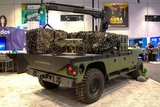
Oshkosh to reset US Army M-ATV fleet


Oshkosh has won a contract from the US Army to reset its Mine Resistant Ambush Protected (MRAP) All-Terrain Vehicles (M-ATVs), the company announced on 5 February.
The programme to reset 800 Oshkosh-made MRAP M-ATVs will help the army standardise its M-ATV fleet configuration and achieve 100% mission readiness of its primary MRAP platform.
Oshkosh won a reset contract for 500 M-ATVs on 6 August 2014 and three additional contract options for 100 M-ATVs each on 12 December. It has already begun deliveries of the reset vehicles and will continue to deliver them up to September 2015.
The reset process for M-ATVs begins with a comprehensive vehicle configuration and condition inspection. After this, the company completes repairs, replaces missing parts and installs the necessary upgrade kits to match the current configuration of each M-ATV variant in the enduring fleet. These kits include automatic fire extinguishing systems, an underbody improvement kit and other safety-related improvements and more.
John Bryant, senior vice president, defence programmes, Oshkosh Defense, said: 'The M-ATV reset programme will ensure that all soldiers operating in M-ATVs will have fully-capable, mission-ready vehicles with all of the latest protection and technologies.'
Related Equipment in Defence Insight



More from Land Warfare
-
![US Army moves towards calls for bids for medium UGV as competitors warm up]()
US Army moves towards calls for bids for medium UGV as competitors warm up
The US Army’s Medium Modular Equipment Transport Trailer (M-METT) programme is planned to provide a platform between Increment II of Small Multipurpose Equipment Transport and the Palletized Load System.
-
![Why bridging the gap between military and COTS systems is key to seamless defence comms (Studio)]()
Why bridging the gap between military and COTS systems is key to seamless defence comms (Studio)
Technology that enables armed forces to leverage existing network infrastructure can be a game-changer in many combat scenarios.
-
![UK MoD clears British Army’s Ajax saying “no safety concerns when operated properly”]()
UK MoD clears British Army’s Ajax saying “no safety concerns when operated properly”
The British Army’s Ajax armoured personnel carrier has a chequered history but hopes were high when Initial Operating Capability was declared last year. More problems saw operations suspended but the MoD reports it has identified the problems and short- and medium-term solutions.