Open menu Search

Eurosatory 2026: Land modernisation programmes gather pace across Europe and beyond

17th June 2026 - 00:44 GMT | by Christopher F Foss

RSS

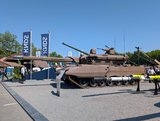
The Dragon (8x8) infantry fighting vehicle for the Spanish Army was originally developed by General Dynamics European Land Systems -Santa Barbara Sistemas. (Photo: Christopher F Foss)

New armoured vehicles, artillery systems and robotic platforms on display at Eurosatory 2026 highlight how armies are seeking greater mobility, firepower, survivability and automation as they modernise ageing fleets and adapt to lessons from recent conflicts.

Land force modernisation remains a major theme at Eurosatory 2026, with programmes ranging from next-generation artillery and armoured vehicles to robotic combat systems demonstrating how militaries are adapting to evolving operational requirements.

Recent conflicts, particularly in Ukraine, have reinforced the importance of long-range fires, battlefield mobility, survivability and the ability to operate in increasingly contested environments.

The result is renewed investment in both traditional platforms and emerging technologies, with many countries seeking to replace Cold War-era systems while simultaneously preparing for future battlefield concepts.

Spain to invest billions of dollars on howitzers and other vehicles as it looks to select new tanks

Artillery lessons from the war in Ukraine spotlight future capability priorities

One notable development is Spain’s effort to renew key elements of its land forces. Indra has established a new company, Indra Land Vehicles, which has been tasked with developing a new generation of tracked and wheeled armoured fighting vehicles (AFVs) and artillery systems for the Spanish Army.

The programme is intended to replace a number of ageing platforms currently in service and includes a tracked 155mm self-propelled artillery system and a wheeled 155mm self-propelled gun based on technology from South Korea’s Hanwha Aerospace.

The tracked platform is expected to replace Spain’s M109A5 self-propelled artillery fleet, while the wheeled system is intended to succeed older towed artillery assets.

Additional programmes include a new 8x8 amphibious combat vehicle for the Spanish Marine Corps to replace current Piranha vehicles, as well as a wheeled bridge-layer capable of deploying a bridge spanning up to 24m and supporting Military Load Class 80 vehicles. The latter is intended to replace older tank-based armoured vehicle-launched bridges.

Indra’s growing role in the land sector comes as TESS Defence, part of the wider Indra Group, continues work on the Dragon 8x8 vehicle programme for the Spanish Army.

The platform was originally developed by General Dynamics European Land Systems–Santa Bárbara Sistemas (GDELS-SBS) and is based on the General Dynamics Land Systems MOWAG Piranha.

Spanish industry plays a significant role in the programme, with SAPA supplying the transmission, EM&E Group providing the turret and Indra delivering a range of electronic systems and other components. The programme has, however, experienced schedule delays.

Four baseline Dragon variants are planned: an infantry fighting vehicle (IFV), engineer combat vehicle, armoured command post and forward observer vehicle. The latter is equipped with a retractable mast-mounted sight for target acquisition and observation, as well as automatic target coordinate calculation and tracking-prediction capabilities.

GDELS-SBS has also supplied a significant number of hulls for the UK Ajax tracked vehicle programme, which has experienced delays associated with a number of technical issues, including excessive vibration. Separately, the company continues work on the Spanish Army’s Pizarro IFV upgrade programme.

Artillery modernisation is also evident beyond Europe. Indian company Kalyani Strategic Systems is using Eurosatory to showcase its MArG 39 BR mounted gun system in Europe for the first time, reflecting growing competition within the global artillery market.

Being shown for the first time in Europe is the Kalyani Strategic Systems 155 mm/39 cal MArG 39 BR self-propelled artillery system (Photo: Christopher F Foss)

Mounted on a protected 4x4 chassis, the MArG 39 BR combines strategic mobility with a 155mm/39 calibre artillery weapon designed to support rapid deployment and shoot-and-scoot tactics intended to reduce vulnerability to counter-battery fire.

The system carries 18 rounds of ammunition and incorporates a computerised fire-control system and muzzle velocity radar to improve accuracy. According to the company, maximum firing rates are 10 rounds in three minutes and 42 rounds in one hour, subject to ammunition resupply.

Armenia has become the first export customer for the MArG 39 BR and has also received deliveries of the Advanced Towed Artillery System (ATAGS), a 155mm/52 calibre system. Kalyani’s broader artillery portfolio now includes mounted gun systems with 39, 45 and 52 calibre weapons as well as a Mounted Gun System based on an 8x8 platform fitted with an automatic ammunition handling system.

While traditional land systems continue to evolve, uncrewed platforms are attracting growing attention across the exhibition.

Milrem Robotics and Moog are displaying a version of the HAVOC Robotic Combat Vehicle equipped with the Reconfigurable Integrated Weapon Platform (RIwP), configured to address short-range air-defence and counter-uncrewed aerial system (C-UAS) requirements.

Milrem Robotics HAVOC Robotic Combat Vehicle fitted with the Moog Reconfigurable Integrated Weapons Platform optimised for the air defence and counter UAV mission. (Photo: Moog)

The demonstrator combines a Northrop Grumman 30mm cannon, machine gun, short-range air-defence missiles, electronic warfare capabilities and smoke grenade launchers on an uncrewed 8x8 platform. According to Moog, the modular design allows weapon configurations to be tailored to specific operational requirements and can also accommodate anti-armour weapons.

The system reflects increasing interest in reducing risk to personnel while maintaining mobility and firepower in contested environments. However, questions remain regarding the future employment of larger uncrewed ground vehicles, including command-and-control arrangements, levels of autonomy and how such systems will be integrated into existing force structures.

The broader trend towards modernisation is also evident elsewhere across Eurosatory. Leonardo Rheinmetall Military Vehicles (LRMV) has outlined plans for a new generation of heavy tracked vehicles to support Italian Army modernisation, including a new main battle tank and the Army Armoured Combat System infantry fighting vehicle family. Both programmes place a strong emphasis on digitisation, survivability and future growth potential.

Meanwhile, Rheinmetall has expanded its Caracal range with a new 6x6 air assault vehicle variant designed to provide increased payload and mission flexibility while building on an existing programme already ordered by Germany and the Netherlands. More than 3,000 Caracal 4x4 vehicles have already been ordered, underlining continued demand for highly mobile light tactical platforms.

Taken together, these developments highlight how land-force modernisation is increasingly focused on balancing proven capabilities with emerging technologies. Traditional requirements for firepower, protection and mobility remain central, but they are now being complemented by greater automation, digitalisation, network integration and uncrewed systems.

New wheeled howitzer [Spain]

M109 Paladin Replacement [Spain]

Havoc 8x8 RCV

Christopher F Foss

Author

Christopher F Foss


Christopher F Foss is an internationally recognised authority on armoured fighting vehicles, artillery and other weapon systems, …

Read full bio

Share to

Linkedin