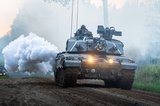
How to breach a minefield: from traditional systems to modern techniques in action
A Terrier manoeuvre support vehicle fitted with a Pearson Engineering Full Width Mine Plough, seen here in raised position. (Photo: BAE Systems)
The news from Ukraine has again shown that antitank minefields and other obstacles on the battlefield, such as deep trenches, can play a key role in both offensive and defensive operations. Given this, there will always be a need to clear them, both during and after a conflict.


In defensive operations, minefields can be used to channel the opposing force into kill zones that are covered not only by antitank guided weapons, but also earmarked for accurate mortar, artillery and artillery rocket systems fires.
There are many types of antitank mines in use, ranging from older metal ones fitted with a pressure fuze to the latest non-metallic types, which can be equipped with more advanced fuzes such as magnetic or ones that let multiple vehicles pass before being set off.
Minefields can still be cleared by hand if the mines are near the surface; if laid deeper, however, they must
Our news & analysis is now part of Defence Insight®
A Basic-level or higher Defence Insight subscription is now required to view this content.

More from Land Warfare
-
![DVD 2026: British Army’s Ajax back in the hands of users as part of a gradual return]()
DVD 2026: British Army’s Ajax back in the hands of users as part of a gradual return
The introduction of Ajax vehicles into British Army service was stopped after operator health issues were reported during an exercise, but manufacturer General Dynamics Land Systems UK believes work over the past 10 months has dealt with the problems.
-
![Europe commits to long-range fires but countries move in different directions]()
Europe commits to long-range fires but countries move in different directions
Sweden, Croatia and France are pursuing different rocket artillery solutions as European armies seek greater reach, survivability and industrial resilience.
-
![MAAF to test Britain’s shift from armour to distributed lethality in Estonia]()
MAAF to test Britain’s shift from armour to distributed lethality in Estonia
The bilateral agreement between the UK and Estonia comes as both countries explore how dispersed troops, drones, digital targeting, anti-tank weapons and increasingly long-range fires can complement the combat mass traditionally provided by heavy armour.
-
![Polaris expands Arctic mobility offering as US military orders grow]()
Polaris expands Arctic mobility offering as US military orders grow
The Military 850 Voyageur 155 Crossover has secured orders from the US Army, Air Force and Marine Corps, addressing demand for agile Arctic mobility with passenger, cargo and towing capacity.