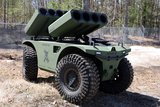
Greece opts for PULS long-range artillery as demand for capability surges
Elbit Systems will collaborate with Greek industry to produce the PULS artillery rocket system in country. (Photo: Elbit Systems)
Greece’s selection of PULS makes it the sixth European country to choose the system and follows Sweden’s plan to buy HIMARS and Norway’s selection of Chunmoo artillery systems. The diverse choices for a similar capability highlight demand and a desire for European industrial capacity.


Greece has ordered the Elbit Systems PULS (Precise and Universal Launching System) modular, truck‑mounted, multiple‑launch artillery rocket system under a €650 million (US$750 million) contract signed on 6 April.
The contract will be fulfilled over the next four years and will include an additional 10-year period of follow-on support.
According to a statement from Elbit Systems, the contract is for launchers and a munition package which includes training rockets, operational precision-guided rockets for various ranges and loitering munitions.
The number of systems ordered was not disclosed but the Netherlands ordered 20 PULS in May 2023 for approximately US$305 million to
Our news & analysis is now part of Defence Insight®
A Basic-level or higher Defence Insight subscription is now required to view this content.


More from Land Warfare
-
![Laser weapon solutions are emerging as Europe confronts air defence cost imbalance]()
Laser weapon solutions are emerging as Europe confronts air defence cost imbalance
Europe’s air defence debate is increasingly shaped by the blunt economics of the field. While high-value interceptor missiles can effectively shoot down cheap drones, doing so at scale presents cost challenges.
-
![ARX Robotics expands in UK following British Army backing for uncrewed platforms]()
ARX Robotics expands in UK following British Army backing for uncrewed platforms
Following an order from the British Army, ARX Robotics has begun manufacturing autonomous ground platforms in the UK. Christopher Foss examines the company's growing range of systems.
-
![Textron unveils a smaller, low-cost variant of the Ripsaw family of UGVs]()
Textron unveils a smaller, low-cost variant of the Ripsaw family of UGVs
Ripsaw M1 has been designed to support the US Marine Corps’ littoral missions by carrying diverse types of payloads and performing multiple missions. Shephard spoke with Textron to find out more.
-
![UK plans to adopt “phased approach to restarting” British Army Ajax programme]()
UK plans to adopt “phased approach to restarting” British Army Ajax programme
The introduction of Ajax vehicles into British Army service was stopped after health issues during an exercise. However, an investigation reported “no single causal mechanism of the symptoms reported by our soldiers but rather a combination of multiple factors”.