Eurosatory 2026: Updated S-KAPS ready to neutralise drone threat
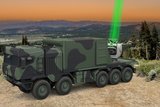
An artist’s impression of the latest S-KAPS counter-drone system installed on a wheeled armoured vehicle with the Lacroix dischargers on top of the platform at the rear. (Image: Lacroix)
Launched at Eurosatory 2026, the revamped Soft-Kill Advanced Protection System (S-KAPS) counter-UAS package has been developed by three French SMEs, Lacroix, Bertin Technologies and MC2 Technologies as a private venture.


The latest S-KAPS is an evolution of a previously announced system but optimised for the increasing threat on the battlefield from small uncrewed aerial vehicles (UAVs) which can carry a lethal top-attack warhead.
The original S-KAPS, also known as AOS, linked four lasers on the platform to provide coverage through 360 degrees and was connected to a series of Lacroix dischargers launching Galix munitions via a dedicated control module inside the platform.
This version has been demonstrated to French and NATO delegations since it was first revealed in 2024.
The next-generation S-KAPS, shown at Eurosatory 2026 for the first time,
Our news & analysis is now part of Defence Insight®
A Basic-level or higher Defence Insight subscription is now required to view this content.


More from Eurosatory 2026
-
![Eurosatory 2026 roundup: uncrewed, counter-uncrewed and new vehicles define direction]()
Eurosatory 2026 roundup: uncrewed, counter-uncrewed and new vehicles define direction
Uncrewed and counter-uncrewed systems were a major feature of this edition of Eurosatory 2026 along with programme updates and first sight of new main battle tanks.
-
![Eurosatory 2026: Iran’s attacks on UAE have “accelerated” Edge’s plans, says company]()
Eurosatory 2026: Iran’s attacks on UAE have “accelerated” Edge’s plans, says company
The UAE’s Edge has undergone massive changes since it was formed in 2019, from acquisitions to partnerships, and has now set up a European division in Paris.
-
![Eurosatory 2026: As MGCS stalls, has Europe’s new MBT been unveiled?]()
Eurosatory 2026: As MGCS stalls, has Europe’s new MBT been unveiled?
Eurosatory 2026 saw a number of main battle tanks on display, including two new platforms which could be the future of European tanks.
-
![Eurosatory 2026: MARSS and parent company EOS expand air defence capability]()
Eurosatory 2026: MARSS and parent company EOS expand air defence capability
MARSS became part of EOS Defence earlier this year, bringing together the former’s C2 NiDAR and Nation Shield air defence products with the latter’s suite of effectors and sensors.
-
![Eurosatory 2026: Wartime iteration gives Ukraine an edge as future UAV exporter]()
Eurosatory 2026: Wartime iteration gives Ukraine an edge as future UAV exporter
As industrial-scale drone production proves its battlefield worth in Ukraine, what happens to that production capacity and knowhow once the guns fall silent – and is Ukraine about to become one of the world’s most credible UAV export partners?
-
![Eurosatory 2026: Pearson Engineering to send AI mine detecting systems into Ukraine]()
Eurosatory 2026: Pearson Engineering to send AI mine detecting systems into Ukraine
Pearson Engineering’s Threat-Sense system is designed to use imaging from drones to geolocate scattered mines and support uncrewed systems in defeating the threats.