Eurosatory 2026: Pearson Engineering to send AI mine detecting systems into Ukraine
Threat-Sense provides AI-processed information to devices and displays. (Photo: Pearson Engineering)
Pearson Engineering’s Threat-Sense system is designed to use imaging from drones to geolocate scattered mines and support uncrewed systems in defeating the threats.


Pearson Engineering is to provide Ukraine with two systems of Threat-Sense, the company’s AI-based software and unit which detects, identifies and geolocates surface-laid explosive threats using vision from uncrewed and crewed platforms.
Threat-Sense is a new business for Pearson Engineering which, historically and in recent business, has been more focused on combat engineering capabilities for armoured vehicles, although it has signed agreements with vehicle and uncrewed ground vehicle (UGV) manufacturers.
The fully passive autonomous system assesses a visual input against a pre-programmed and what the company describes as a highly trainable threat library and highlights any threat that is detected on an agnostic user interface, which can range from large multifunction displays to handheld devices.
Related Articles
Pearson Pioneer remote minefield breaching system set for trials with NATO countries
IDEX 2025: Milrem teams up with Pearson to develop large uncrewed demining platforms
Pearson Engineering remote mine-clearance system ploughs on
It is a modular system compatible with any military vehicle. The platform has been proven with logistics vehicles, protected patrol vehicles and armoured personnel carriers and has been successfully demonstrated to NATO members while integrated with an uncrewed aerial vehicle (UAV).
According to a company official, Threat-Sense achieved more than 80% true positive detection, less than 10% false alarm rates and detected 95% of targets in the NATO trials.
Speaking to Shephard at Eurosatory 2026, the official noted: “The software is continuously improved based on user feedback and ongoing trials with the UK Ministry of Defence and British Army Royal Engineers.”
The deployment of systems to Ukraine provides the company with the opportunity to evaluate the system in what can only be described as a target-rich environment with mines of various sizes scattered across and beyond frontlines.
The official said: “You have got a UAV or UAVs flying ahead of a vehicle; it can tell the people in that vehicle if there are surface-laid threats ahead and one of the most prolific threats in Ukraine at the moment is scattered munitions.
“This is what this software system aims to counter and target, and we see that it’s complementary to a lot of our equipment. It means that you don’t have to send someone out on a reconnaissance mission to do that.”
Plans for further cooperation with vehicle makers
At the exhibition, the DOK-ING MV-8 Komodo uncrewed breaching system, which is supported by Rheinmetall Land Systems engineering technology and clearance capabilities of Pearson Engineering, was unveiled.
It is described by companies as “the first uncrewed mine-breaching system built on a latest-generation [and] developed and tested in less than six months from initial discussions”. Two variants of the uncrewed mine-breaching system are in test: light and heavy.
It is integrated with Pearson Engineering’s Remote Combat Vehicle-Pioneer minefield breaching modular mission payload, incorporating its full width mine plough and lane marking system technology.
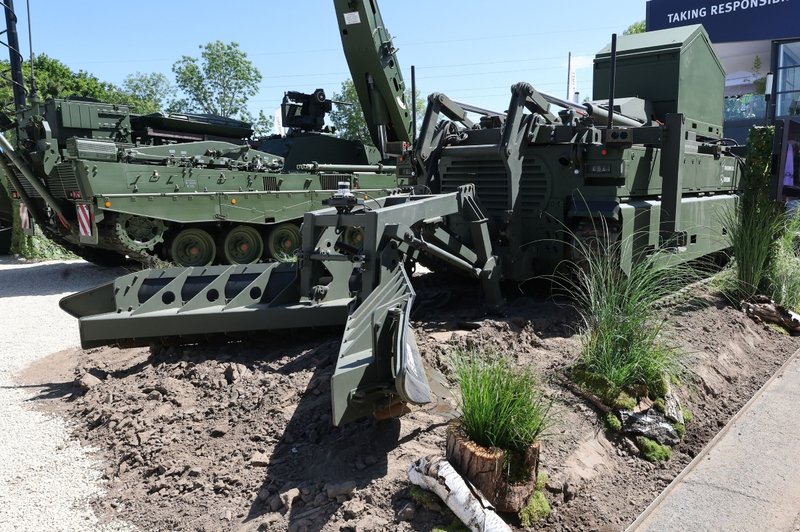
In addition to the mine plough, there’s the option to mount Rheinmetall mine clearing line charge, Plofadder, onto the system. Future integrations will enable semi-autonomous and autonomous mission execution for the all-terrain and all-weather platform through the incorporation of Rheinmetall’s autonomy solution, the Path A-Kit.
Integration with uncrewed systems is not a new area for Pearson. In February it signed a Memorandum of Understanding (MoU) with Milrem Robotics to integrate the former’s engineering technology onto the latter’s UGVs.
The MoU will see Pearson, owned by Israel’s Rafael Advanced Defense Systems, and Milrem, owned by the UAE’s Edge Group, develop mission-specific UGVs for the Middle East and North Africa region.

More from Eurosatory 2026
-
![Eurosatory 2026 roundup: uncrewed, counter-uncrewed and new vehicles define direction]()
Eurosatory 2026 roundup: uncrewed, counter-uncrewed and new vehicles define direction
Uncrewed and counter-uncrewed systems were a major feature of this edition of Eurosatory 2026 along with programme updates and first sight of new main battle tanks.
-
![Eurosatory 2026: Iran’s attacks on UAE have “accelerated” Edge’s plans, says company]()
Eurosatory 2026: Iran’s attacks on UAE have “accelerated” Edge’s plans, says company
The UAE’s Edge has undergone massive changes since it was formed in 2019, from acquisitions to partnerships, and has now set up a European division in Paris.
-
![Eurosatory 2026: As MGCS stalls, has Europe’s new MBT been unveiled?]()
Eurosatory 2026: As MGCS stalls, has Europe’s new MBT been unveiled?
Eurosatory 2026 saw a number of main battle tanks on display, including two new platforms which could be the future of European tanks.
-
![Eurosatory 2026: MARSS and parent company EOS expand air defence capability]()
Eurosatory 2026: MARSS and parent company EOS expand air defence capability
MARSS became part of EOS Defence earlier this year, bringing together the former’s C2 NiDAR and Nation Shield air defence products with the latter’s suite of effectors and sensors.
-
![Eurosatory 2026: Wartime iteration gives Ukraine an edge as future UAV exporter]()
Eurosatory 2026: Wartime iteration gives Ukraine an edge as future UAV exporter
As industrial-scale drone production proves its battlefield worth in Ukraine, what happens to that production capacity and knowhow once the guns fall silent – and is Ukraine about to become one of the world’s most credible UAV export partners?
-
![Eurosatory 2026: Locally produced loitering munition destined for UAE Navy, says MBDA]()
Eurosatory 2026: Locally produced loitering munition destined for UAE Navy, says MBDA
The contract signed between MBDA and Fly-R will see diamond-shaped loitering munitions developed and prepared in the UAE. How does this move fit into wider market trends in the region?