Aselsan has started producing Akkor active protection system for Altay tank
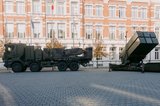
Generic armoured personnel carrier fitted with Aselsan 120mm mortar system and showing the four Pulas to give 360° coverage (left) with a generic 8x8 with the Aselsan turret with one Akkor twin round launcher on the roof (right). (Photo: author)
Akkor is an active protection system (APS) developed by Aselsan, equipped with both hard- and soft-kill functionalities. It provides protection against antitank missiles and rockets for armoured vehicles and is designed for Turkey’s Leopard and Altay tanks.


Turkey’s Aselsan confirmed to Shephard at the Defence IQ International Armoured Vehicle conference earlier this week that their Akkor hard-kill/soft-kill APS is now in production for the Turkish Army.
Akkor will first be fitted to the BMC Altay main battle tank (MBT) which is now in production after some delays due to a change in the prime contractor.
The Altay MBT was originally designed and developed by Otokar who also built the prototype vehicles but the production contract for 250 units was awarded to BMC and production is expected to ramp up to eight units a month.
The second application
Our news & analysis is now part of Defence Insight®
A Basic-level or higher Defence Insight subscription is now required to view this content.

More from Land Warfare
-
![Billion-dollar Belgium deal for NASAMS creates multinational air defence system]()
Billion-dollar Belgium deal for NASAMS creates multinational air defence system
The National Advanced Surface-to-Air Missile System (NASAMS) is in service on five continents with more than 120 platforms delivered. The system will now form part of Belgium’s Blue Dome air defence system alongside new orders for Skyranger air defence and Thales radar systems.
-
![Clearer military requirements could unlock UGV market growth]()
Clearer military requirements could unlock UGV market growth
Western armies continue to test uncrewed ground vehicles, but wider procurement will depend on turning ambitions for autonomy into defined operational roles and funded requirements.
-
![Can NATO’s CUAS marketplace turn urgent demand into deliveries?]()
Can NATO’s CUAS marketplace turn urgent demand into deliveries?
Framework contracts and leasing options aim to shorten acquisition timelines, while manufacturing partnerships could help suppliers scale production to meet allied demand.
-
![A medium UGV market emerges as the US weighs up its options]()
A medium UGV market emerges as the US weighs up its options
The US is pursuing multiple UGV programmes, from commercial robotic platforms to new autonomy technologies. The combination of these efforts could prove key to turning ambition into operational capability.