Active vehicle protection comes to the forefront as Trophy and Iron Fist secure contracts
Trophy is shown here fitted to a Leopard tank with radars on the turret to left and right of the barrel. (Photo: Rafael)
Experience on the battlefield is accelerating the adoption of active protection systems as technologies continue to evolve to reflect shifting global defence needs.


Active protection systems to defend large vehicles and main battle tanks (MBTs) first appeared as Russian systems in the late 1970s and 1980s, before truly coming to the forefront of technology through Israeli efforts in the 2000s.
The majority are modular and agnostically designed to allow them to be bolted on, federated or integrated, with two Israeli systems – Rafael Armaments Development Authority’s Trophy and Elbit Systems Iron Fist – proving particularly popular.
The Rafael system is sold through EuroTrophy, a joint venture with General Dynamics Europe Land Systems, which along with Iron Fist has announced contracts in the past few weeks.
Related Articles
Iron Fist active protection system ordered for Bradley upgrade
EuroTrophy systems contracted for Leopard 2A8 tank buyers as demand rises
Elbit Systems revealed on 26 January that it had been awarded a US$228 million contract from General Dynamics Ordnance and Tactical Systems (GD-OTS) to supply Iron Fist systems over a period of three years. The systems will be installed on Bradley infantry fighting vehicles (IFVs). Based on Shephard Defence Insight’s estimated unit cost of $300,000, this is likely to be for up to 750 systems.
KMW+Nexter Defense Systems (KNDS) Germany announced on 19 January that it had signed a €330 million ($384 million) deal with EuroTrophy to supply Trophy systems to the four most recent Leopard 2A8 MBT customers. The countries – Lithuania, the Netherlands, Czech Republic and Croatia – have all ordered the latest iteration of the Leopard tank and the baseline for this system includes Trophy.
Israeli options lead the field
More than 2,000 Trophy systems have been sold and have accrued significant combat experience protecting Israeli Army vehicles during ground operations since the systems’ introduction in 2010.
At the heart of the system is an Israel Aerospace Industries’ Elta division EL/M-2133 S-band (2.3GHz to 2.5GHz/2.7GHz to 3.7GHz) and C-band (5.25GHz to 5.925GHz) radar. Antennas are positioned to provide 360° of surveillance around the vehicle, usually at each corner of the turret.
Once the radar has detected an incoming projectile, the Trophy’s computer calculates the projectile’s anticipated trajectory and then ascertains the optimum moment for the system to launch its countermeasure. The countermeasure takes the form of several Multiple Explosively Formed Penetrators.
The system demonstrated its capability during 2014’s Operation Protective Edge, an Israeli counter-insurgency effort in the Gaza Strip directed against Hamas operatives.
It is the default solution for Leopard 2A8 MBTs and as a number of these vehicles enter service, Trophy will become more prevalent. It is also likely to be the system for British Army Challenger 3 MBTs but so far systems have only been ordered for evaluation.

Iron Fist uses an active electronically scanned array radar and an infrared detector to perform the initial detection of an incoming munition and its tracking. It is a hard-kill system as it employs a projectile which explodes within the path of the munition.
This will either detonate the munition’s warhead a safe distance from the vehicle or knock it off course. The ability of the explosion to deflect the trajectory of the munition away from the vehicle is what makes Iron Fist effective against kinetic energy penetrators.
This also renders it safer to use in urban areas, or when personnel or soft-skinned vehicles are in the vicinity of the platform, as opposed to systems employing fragmentation warheads.
European and other solutions
Other systems have been developed but none have seen the success or validation of the Israeli options.
In the mid-2010s Lockheed Martin developed an open-architecture controller for the US Army’s Modular Active Protection System (MAPS). In 2019 an $11 million contract was awarded to Rheinmetall for the US Army to test the StrikeShield APS.
Unlike most others mentioned, Hensoldt Sensors Multifunctional Self-protection System (MUSS) is a soft-kill active protection system designed for installation on armoured fighting vehicles.
Equipped with UV sensors and a laser warning receiver, the system can detect and track incoming anti-tank guided missiles, as well as trace the source of the incoming missile. It can then either jam the missile’s guidance system or, if the missile is jam-resistant, launch pyrotechnic obscurant countermeasures to confuse the missile’s targeting system.
Although development of Rheinmetall’s MUSS began in 1995, the system did not enter service until 2015, when it was integrated into the German Army’s Puma IFV, representing approximately 350 MUSS equipment sets.
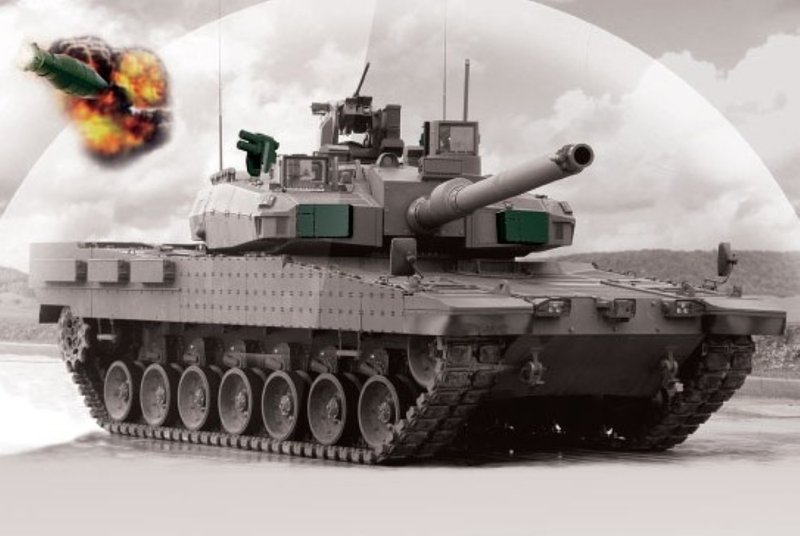
Another notable system is Akkor (AKtif KORuma) from Turkey’s Aselsan. Akkor is planned for the country’s Altay MBT but has already been installed on the army’s Leopard 2A4 MBTs. Features of the Akkor system include a high-resolution hard-kill radar, laser warning sub-system, soft-kill launchers and an electronic warfare computer, control panel and display unit.
Demand likely to increase as use expands
While the original systems may have been driven by Russia’s experience in Afghanistan and Israel’s operations at home and in neighbouring countries, the ongoing war in Ukraine and recent Israeli operations in Gaza have further highlighted the need.
One of the key improvements to Trophy, as highlighted by Rafael, is protection for the vehicle from top attack from loitering munitions and uncrewed aerial systems (UAS). Limited detail has been provided on the counter-UAS capability, which is reflective of the confidential nature of high-level details for all systems.
Company officials noted that testing has shown success against Class 2 and Class 3 UAS without alteration to the platform’s base hardware.
Related Programmes in Defence Insight
Related Equipment in Defence Insight



More from Land Warfare
-
![Predicted air defence spending boom opens doors to Indian industry]()
Predicted air defence spending boom opens doors to Indian industry
Recent conflicts have created a surge in interceptor demand worldwide while exposing potential supply chain challenges, positioning India as a cost-effective partner and scalable supplier.
-
![March land forces roundup: A new war confronts the old drone problem]()
March land forces roundup: A new war confronts the old drone problem
The attack by the US and Israel on Iran which began at the end of February presented a Ukraine-like scenario of drone-led warfare – in fact the same drone type in the Shahed – and the problem of how to counter them.
-
![New US$1.4 billion package to boost Canada’s defence capabilities]()
New US$1.4 billion package to boost Canada’s defence capabilities
The Canadian defence department has outlined major investments in ISR solutions, small arms and ammunition production capabilities as the country pushes for greater self-reliance to bolster its forces and its supply chain.
-
![US Army moves towards calls for bids for medium UGV as competitors warm up]()
US Army moves towards calls for bids for medium UGV as competitors warm up
The US Army’s Medium Modular Equipment Transport Trailer (M-METT) programme is planned to provide a platform between Increment II of Small Multipurpose Equipment Transport and the Palletized Load System.