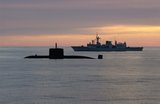
US Navy requests Kongsberg NSM firing from LCS


Kongsberg will test fire its Naval Strike Missile (NSM) from the US Navy’s Littoral Combat Ship (LCS) under the Foreign Comparative Testing programme. Kongsberg announced the firing, which will take place in September, on 17 September.
The firing was requested by the US Navy to demonstrate the capability to engage a surface target at a range of 100 nautical miles from an LCS class ship. The test will take place from the USS Coronado, an Independence-class LCS.
Harald Ånnestad, president, Kongsberg Defence Systems, said: ‘We are very pleased that the US Navy has decided to evaluate the NSM missile. This contract does not however include any commitment for the US Navy beyond the test, but confirms NSM`s unique capabilities and the test will enable the US Navy to study it closer in a realistic scenario.’
This demonstration follows a successful NSM live fire event from the Royal Norwegian Navy´s Fridtjof Nansen-class frigate witnessed by the US Navy during the recently completed Rim of the Pacific 2014.

You may also like
More from Naval Warfare
-
![Australia is ramping up its uncrewed surface fleet as Sea Archer lines up for key requirement]()
Australia is ramping up its uncrewed surface fleet as Sea Archer lines up for key requirement
As advances in uncrewed technology increasingly shape Australia’s maritime future, Shephard spoke with the country’s head of navy capability and a Leidos Australia executive about the operational advantages behind the shift.
-
![What does Saab’s operations shake-up mean for its new ‘Naval’ chapter?]()
What does Saab’s operations shake-up mean for its new ‘Naval’ chapter?
Saab’s merger of its Kockums and Naval Combat Systems divisions into a single business area called Naval, effective 1 April 2026, aims to enhance efficiency, innovation and competitive positioning in the naval sector.
-
![Iran and the future of amphibious operations: crewed and uncrewed solutions]()
Iran and the future of amphibious operations: crewed and uncrewed solutions
Amphibious operations are a very unique type of military operation, and global defence industries are developing new solutions to enhance capabilities and efficiency.
-
![US Navy to acquire and test uncrewed surface vessel prototypes by the end of FY2026]()
US Navy to acquire and test uncrewed surface vessel prototypes by the end of FY2026
The new autonomous surface vessels are planned to be operationally fielded in FY2027, following the completion of on-water trials.
-
![Hanwha Ocean and TKMS are firming up their Canadian next-gen submarine proposals]()
Hanwha Ocean and TKMS are firming up their Canadian next-gen submarine proposals
CPSP competitors are proposing platforms fitted with advanced, next-generation capabilities to be built and sustained in cooperation with the Canadian industry.