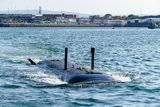
Tomahawk naval missile completes production acceptance test


The US Navy’s Tomahawk land attack missile completed a production acceptance test using functional ground test (FGT) capability on 19 March.
The all-weather, long-range, sub-sonic cruise missile can be used for land warfare, and is launched from naval surface ships and submarines.
Michael Spriggs, senior engineer and FGT test conductor, Naval Surface Warfare Center, said: ‘This latest FGT - which is the 84th we’ve conducted in the past 25 years - was in support of the RGM-109E Block IV, Vertical Launch System (VLS) full-rate production lot acceptance.
‘For the test, we used a single, representative missile from the full-rate production line to demonstrate the capability of this lot to perform mission requirements. The data we collected from the test will be used to verify the manufacturing processes and quality of missiles produced.’
During the test, the missile is operated at the level that it would be exercised in an operational flight through the detonation command. However, the missile remains restrained in a specially-designed test stand and is fitted with an inert warhead.
Mike Gardner, FGT software lead, Naval Surface Warfare Center, said: ‘After launch, real-time, six-degree-of-freedom accredited mission simulation software provides inputs to the missile’s guidance system to mimic flight, targeting and detonation. The missile ‘flew’ for about an hour and 45 minutes before it successfully acquired the target.’
Spriggs added: ‘Preliminary assessment indicates this missile performed as expected and all test objectives were achieved.’
Phillip Vaughn, FGT program manager, Naval Surface Warfare Center, said: ‘We anticipate conducting the next FGT later this fiscal year to sample a capsule launching system variant.’

More from Naval Warfare
-
![Five years on: where could opportunities emerge next for AUKUS Pillar II?]()
Five years on: where could opportunities emerge next for AUKUS Pillar II?
Payload commonality, combat systems and electronic warfare are emerging as likely priorities as the trilateral partnership balances building submarines with sharing industrial ecosystems.
-
![From the Baltic to the Gulf: where USV procurement is heading next]()
From the Baltic to the Gulf: where USV procurement is heading next
Saildrone’s new Copenhagen base is one sign of a larger shift, as navies globally turn to uncrewed vessels for surveillance and mine clearance.
-
![Quantum sensing gathers pace as navies eye undersea advantage]()
Quantum sensing gathers pace as navies eye undersea advantage
As AI dominates defence conversations, industry increasingly points to quantum sensing as the technology set to change submarine and uncrewed underwater vehicle operations.