Royal Navy formally commissions HMS Forth


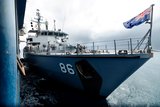
The Royal Navy has formally commissioned the first of its next-generation OPVs, HMS Forth, the navy announced on 13 April.
HMS Forth is the first of five new OPVs designed for counter-piracy, anti-smuggling, fishery protection, border patrol, counter terrorism and maritime defence operations. The vessel is classified as a Batch 2 River-class OPV, and her sisters – Trent, Medway, Tamar and Spey - are a significant upgrade on the original vessels that were designed and built 15 years ago.
HMS Forth will enter service in 2018, while the remaining four ships are all expected to arrive in Portsmouth by 2020.
Built by BAE Systems, HMS Forth is designed for a total crew of around 58, but requires only 34 to go to sea. The new OPVs are faster than their predecessors at 24 knots, have an increased range of 5,500 nautical miles, a 30mm automatic cannon as their main armament, two mini-guns, four machine-guns and are equipped with two Pacific 24 sea boats.
Each ship has an extended flight deck to operate up to Merlin size helicopters. They can accommodate up to 50 embarked Royal Marines for boarding and supporting operations ashore if required.
Related Equipment in Defence Insight

You may also like

More from Naval Warfare
-
![How France’s SNLE 3G programme is reshaping the naval nuclear industrial base]()
How France’s SNLE 3G programme is reshaping the naval nuclear industrial base
Extending far beyond a four-submarine replacement programme, France’s ballistic missile submarine effort is a decades-long industrial initiative designed to preserve the country’s ability to build and sustain nuclear-powered strategic platforms.
-
![China’s mineral processing dominance exposes naval supply chain vulnerabilities]()
China’s mineral processing dominance exposes naval supply chain vulnerabilities
Competition for critical minerals, and China’s dominance of their processing, is emerging as a decisive factor in future naval procurement programmes.
-
![Suppliers await next step in Australia’s mine warfare transition]()
Suppliers await next step in Australia’s mine warfare transition
Australia’s mine countermeasure capability remains in flux as the Huon-class nears retirement, but accelerated investment in autonomous systems is opening a path for industry.
-
![Can the US Navy ask Indo-Pacific allies to do more while training with them less?]()
Can the US Navy ask Indo-Pacific allies to do more while training with them less?
As the Iran War draws US ships and marine corps units away from the Indo-Pacific, curtailed exercises and a temporary carrier gap are exposing tensions between Washington’s demand for more self-reliant allies and the joint training needed to realise that ambition.
-
![How could Rheinmetall’s GMF 140 fit with ongoing programmes in North America?]()
How could Rheinmetall’s GMF 140 fit with ongoing programmes in North America?
With Canada committed to its River-class replacement and the USN pursuing a lower-cost frigate, Rheinmetall will need to demonstrate where the GMF 140 can fill a capability gap in the North American fleet.