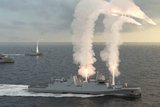
DSIT develops new towed array sonar
DSIT announced on 26 September that it will launch its SwordFish Towed Array Sonar (TAS) system at Pacific 2019 in Australia.
According to the company, the SwordFish complements DSIT’s BlackFish Hull Mounted Sonar system for use at various sea depths and for different mission types.
DSIT’s Fish anti-submarine warfare family is capable of underwater target search, detection, tracking and classification both in passive, active and parallel modes. Each system includes machine learning technologies for automation algorithms, reducing operator workload.
The SwordFish system is connected to a vessel’s stern via a light winch, the cable length of which is determined according to the mission type and requirements. The lightweight TAS system, with its low deck signature, is suitable for frigates, corvettes, OPVs of various sizes, and small vessels such as fast patrol craft.
‘We identified the operational need to locate and track submarines at various depths and in different mission environments, including when using small vessels for either offshore or green waters missions,’ Hanan Marom, VP business development and marketing , stated. ‘SwordFish TAS is designed as a complementary system to the BlackFish HMS and BMS to meet the requirements of a wider range of missions.’



More from Naval Warfare
-
![How France’s SNLE 3G programme is reshaping the naval nuclear industrial base]()
How France’s SNLE 3G programme is reshaping the naval nuclear industrial base
Extending far beyond a four-submarine replacement programme, France’s ballistic missile submarine effort is a decades-long industrial initiative designed to preserve the country’s ability to build and sustain nuclear-powered strategic platforms.
-
![Quantum Systems enters maritime domain with Baltic-focused USV and UUV]()
Quantum Systems enters maritime domain with Baltic-focused USV and UUV
Quantum Systems has launched into the maritime domain with Seavex and Subvex, aiming to close a Baltic Sea ISR gap opened by infrastructure sabotage.
-
![Suppliers await next step in Australia’s mine warfare transition]()
Suppliers await next step in Australia’s mine warfare transition
Australia’s mine countermeasure capability remains in flux as the Huon-class nears retirement, but accelerated investment in autonomous systems is opening a path for industry.
-
![Can the US Navy ask Indo-Pacific allies to do more while training with them less?]()
Can the US Navy ask Indo-Pacific allies to do more while training with them less?
As the Iran War draws US ships and marine corps units away from the Indo-Pacific, curtailed exercises and a temporary carrier gap are exposing tensions between Washington’s demand for more self-reliant allies and the joint training needed to realise that ambition.
-
![How could Rheinmetall’s GMF 140 fit with ongoing programmes in North America?]()
How could Rheinmetall’s GMF 140 fit with ongoing programmes in North America?
With Canada committed to its River-class replacement and the USN pursuing a lower-cost frigate, Rheinmetall will need to demonstrate where the GMF 140 can fill a capability gap in the North American fleet.