How AI is reshaping defence procurement through sustainment
Maintainers complete routine repairs and inspect C-130J Hercules parts at Ramstein Air Base, Germany on 14 May 2026 to ensure mission readiness. (Photo: US Air Force)
Artificial intelligence is not just changing how defence equipment is maintained but how defence programmes are won, creating new opportunities for industry by influencing acquisition decisions and shaping competition.


Procurement authorities are increasingly assessing programmes on their ability to deliver long-term readiness and affordable through-life support. This trend has been sharpened by recent conflicts in the Middle East and Ukraine which have led to a growing recognition of the importance of equipment availability, sustainment and operational costs.
As suppliers embed AI-enabled predictive maintenance, digital twins and intelligent logistics into their sustainment offerings, the importance of these capabilities as a differentiator alongside traditional measures such as platform performance, technical compliance and acquisition cost is growing.
This reflects a broader shift in how defence procurement value is measured. As Chris Morton, global industry director for Aerospace and Defence at IFS, told Shephard: “The long-term sustainment and lifecycle cost of a large capability like an aircraft or a ship is much larger than the procurement cost of that capability.” Rather than focusing solely on the cost of the acquisition, defence organisations are increasingly evaluating the total cost of ownership and operational effectiveness across a capability’s entire service life.
Related Articles
Companies and militaries look to artificial intelligence to improve support of equipment
Fuselage of the first US Army MV-75 Cheyenne tiltrotor “is nearing completion”
The operational benefits of this approach are already becoming evident. According to Lockheed Martin, the C-130J Super Hercules’ AI-enabled HercFusion predictive maintenance suite analyses data from more than 600 onboard sensors, generating around 3GB of data per flight hour, to forecast component failures and enable maintainers to pre-position spares before faults occur. The company reports that operators using HercFusion have achieved a 3% increase in mission capability rates, while one operator also reported a 15% reduction in fuel consumption. These gains illustrate how AI-enabled sustainment can improve aircraft availability while reducing operating costs
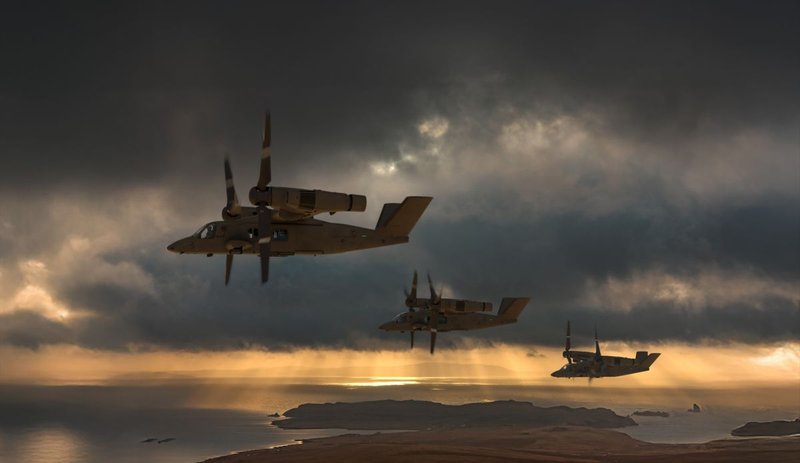
Bell’s MV-75 Cheyenne tiltrotor illustrates how digital sustainment is becoming part of the successful acquisition proposition. In the US Army’s Future Long-Range Assault Aircraft (FLRAA) competition, sustainment was a dedicated subfactor within the product supportability evaluation, requiring bidders to demonstrate how sustainment had been designed into the aircraft and would be delivered throughout its lifecycle. The aircraft received a ‘Good’ rating for sustainment, outperforming the Sikorsky-Boeing Defiant X, which was rated ‘Acceptable’.
Bell’s connected aircraft architecture and Modular Open Systems Approach (MOSA) were designed to improve lifecycle affordability, readiness and future technology integration. While Bell does not explicitly market these capabilities as AI-augmented, they provide the digital foundation needed to support AI-enabled predictive maintenance and logistics as the platform evolves.
Notably, Bell’s Value Adjusted Total Evaluated Price was US$8.087 billion, compared with $4.445 billion for the Sikorsky-Boeing proposal. Despite the substantially higher evaluated price, the US Army determined that Bell’s advantages in engineering design and development and product supportability outweighed the price premium and represented the best overall value.
Similar thinking is shaping the US Army’s Predictive Logistics Initiative, which uses AI-enabled analytics to forecast equipment failures, predict spare parts requirements and optimise maintenance planning before faults occur. By integrating equipment health, maintenance and supply chain data, the US Army aims to shift from reactive support to predictive sustainment, improving readiness while reducing the logistical burden on deployed forces.
Morton noted that IFS is embedding AI algorithms directly into maintenance processes, enabling organisations to model equipment configurations from individual components through to complete platforms. This improves maintenance planning while helping contractors forecast sustainment costs more accurately across the life of a programme.
However, as Morton emphasised, technology alone is not enough: “AI is completely useless if the data that you have is not useful. Get your data right.” For defence organisations, this means establishing a digital thread that connects design, manufacturing, operations and sustainment. Without high-quality, structured and accessible data, even the most advanced AI models cannot deliver accurate predictions or meaningful operational insights.
What’s next?
As defence procurers increasingly seek measurable operational outcomes, including higher fleet availability, reduced maintenance downtime, more predictable sustainment costs and greater resilience across supply chains, this shift presents an opportunity for industry.
Suppliers that can demonstrate how their components, services or technologies contribute to readiness and sustainment outcomes could become increasingly valuable partners to primes pursuing long-term support contracts. Not every supplier needs its own AI strategy, but every supplier needs a readiness and sustainment value proposition.
AI is no longer simply improving sustainment; it is reshaping how defence capability is procured, supported and contracted. For strategy, business development and capture teams, AI-enabled sustainment is increasingly becoming a competitive differentiator that can strengthen bids, support performance-based contracts and influence procurement decisions.
Related Programmes in Defence Insight
Future Long Range Assault Aircraft (FLRAA) (MV-75 Cheyenne II) [USA]
Related Equipment in Defence Insight

More from Farnborough International Airshow 2026 | View all news
-
![FIA 2026: KAI to offer T-50 jet trainer to UK Royal Air Force]()
FIA 2026: KAI to offer T-50 jet trainer to UK Royal Air Force
Another contender for the Royal Air Force's future Hawk trainer replacement programme has emerged, with Korea Aerospace Industries (KAI) putting forward its T-50 as a proven solution that could be manufactured in the UK.
-
![FIA 2026: Honeywell Aerospace targets expansion following June spin-off]()
FIA 2026: Honeywell Aerospace targets expansion following June spin-off
Honeywell Aerospace charted its growth strategy as a standalone company, with CEO Jim Currier pointing to record defence budgets and a $19 billion backlog as drivers of expansion.
-
![FIA 2026: Malloy eyes NATO expansion and Australia for T-150 as it scales up technology]()
FIA 2026: Malloy eyes NATO expansion and Australia for T-150 as it scales up technology
BAE Systems’ Malloy Aeronautics is seeking to expand the international customer base for its T-150 heavy-lift UAV, with NATO users beginning to adopt the platform and Australia identified as a key prospective market.
-
![FIA 2026: Embraer, Anduril sign agreement to develop cruise missile launch capability for the C-390]()
FIA 2026: Embraer, Anduril sign agreement to develop cruise missile launch capability for the C-390
The Brazilian airframer and US developer have announced plans to offer a palletised launch system for the twinjet tactical airlifter.
-
![FIA 2026: Tekever targets British Army’s Project Nyx with hydraulic-powered AR6 drone]()
FIA 2026: Tekever targets British Army’s Project Nyx with hydraulic-powered AR6 drone
As Tekever positions its newly revealed UK-sovereign, autonomous heavy-lift drone family for the British Army's Project Nyx, the company is also eyeing an international future for the capability.
-
![FIA 2026: Boeing pitches Ghost Bat as mature answer to growing CCA demand]()
FIA 2026: Boeing pitches Ghost Bat as mature answer to growing CCA demand
Boeing said demand for collaborative combat aircraft could outstrip what any single supplier can provide, as BAE Systems and Anduril unveiled new platforms at Farnborough International Airshow 2026.