With a wave of upgrades, the MQ-9B is ready for high-tech warfare
GA-ASI’s MQ-9B integrated with AEW&C pods developed in collaboration with Saab.
The modern battlefield is evolving rapidly — threats range from stealthy cruise missiles to coordinated drone swarms. General Atomics Aeronautical Systems, Inc. (GA-ASI) is meeting these challenges head-on with a series of transformative upgrades to its MQ-9B SkyGuardian® and maritime SeaGuardian® remotely piloted aircraft.


Enjoy free access to this sponsored article, all content provided by GA-ASI
From airborne early warning and control (AEW&C) capabilities to long-range weapons integration and precision strike enhancements, the MQ-9B is redefining its role as a force multiplier for high-tech warfare.
Advance notice
One of the most significant advancements to the MQ-9B is airborne early warning (AEW), developed in collaboration with Saab.
Innovative radar pods transform the MQ-9B into a persistent, more risk-tolerant early warning platform capable of detecting and countering a wide range of threats, including cruise missiles and drone swarms.
The AEW&C-equipped MQ-9B both extends the reach of traditional, powerful crewed AEW aircraft and provides an organic capability when those assets are needed elsewhere or are unavailable.
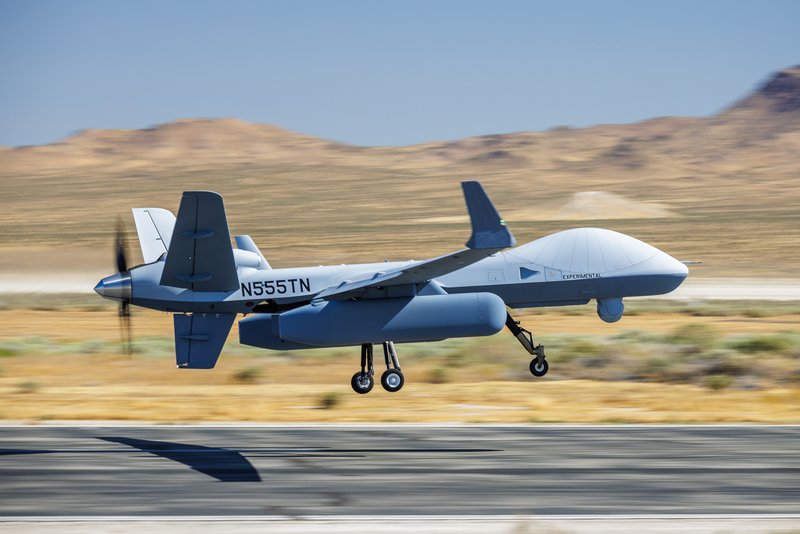
The MQ-9B completed its first flight with AEW&C pods on May 19, 2026, from GA-ASI’s Desert Horizon flight operations facility in Southern California.
GA-ASI recently announced the first flight of the MQ-9B with its AEW&C mission package installed and is gearing up for its first fully operational test later this year.
The AEW&C package on the MQ-9B Short Takeoff and Landing (STOL) variant now in development will give carriers and big-deck amphibious warships the ability to fly AEW missions from their flight decks, which is an essential capability for survivability in an era of precision anti-ship cruise missiles.
Long-distance strike
In addition to its surveillance capabilities, the MQ-9B is developing the capacity to deliver long-range precision strikes.
This upgrade allows the aircraft to engage high-value targets from greater distances, providing commanders with enhanced operational flexibility while keeping the platform safely out of harm’s way.
The integration of long-range weapons, such as KONGSBERG’s Joint Strike Missile and Lockheed Martin’s Long Range Anti-Ship Missile, is particularly valuable in high-end conflicts where standoff capabilities are essential for mission success.
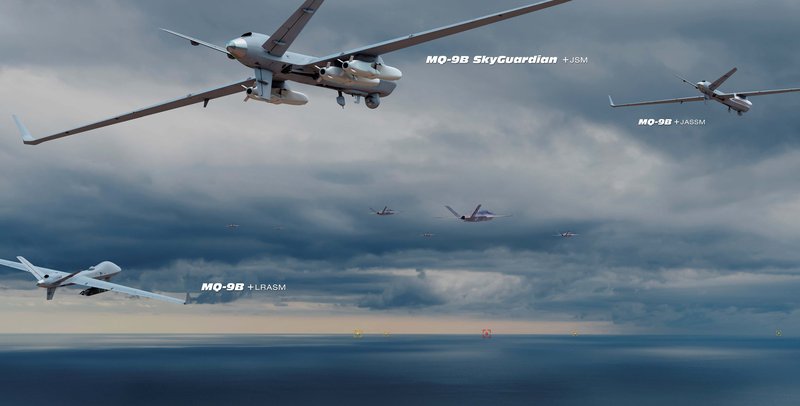
GA-ASI is adding long-range standoff weapons capability to its next-gen MQ-9B SkyGuardian and SeaGuardian uncrewed aircraft.
The MQ-9B’s ability to act as a command-and-control hub further amplifies its strategic value.
Paired with smaller autonomous fighters, such as GA-ASI’s Gambit Series of Collaborative Combat Aircraft (CCA), the MQ-9B provides critical sensors and communications links for coordinated operations.
This synergy enables the MQ-9B to serve as both a reconnaissance asset and a long-range strike platform, making it invaluable for multi-domain operations.
Counter-drone asset
GA-ASI has also integrated the Advanced Precision Kill Weapon System (APKWS) into the MQ-9B’s arsenal, creating the ability to deliver cost-effective precision strikes and defend against drone swarms.
APKWS converts standard 2.75-inch rockets into laser-guided munitions, offering pinpoint accuracy.
In a demonstration earlier this spring, GA-ASI showed how a Reaper® aircraft, part of the MQ-9 family, can be lethally effective against one-way attack drones. Using the APKWS, the MQ-9 was able to intercept aerial targets — forging a path for future integration onto the MQ-9B.
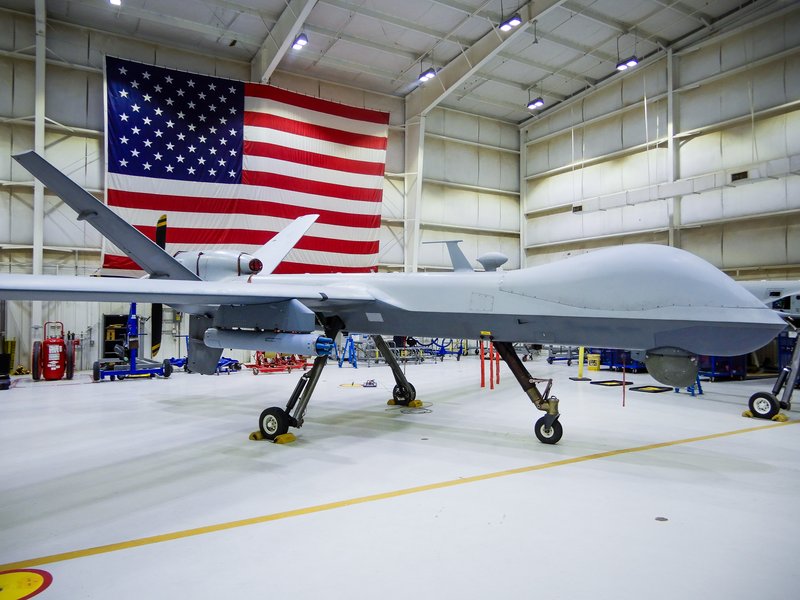
GA-ASI and the U.S. Air Force successfully completed APKWS flight testing on an MQ-9A Reaper in April 2026.
Given the MQ-9B’s class-leading endurance — more than 30 hours in some configurations — an MQ-9B with AEW&C paired with an APKWS-equipped MQ-9B becomes a formidable defence system against drone swarms.
It’s easy to picture a combat scenario in which an AEW&C-equipped MQ-9B would be able to provide early warning of an incoming drone wave attack. A second aircraft armed with APKWS could intercept and destroy the threat ahead of it that is menacing critical infrastructure and warfighters on the ground.
Whether targeting drones, enemy vehicles, or personnel, the MQ-9B equipped with APKWS provides commanders with a reliable and affordable option for precision engagement.
Ready for the future of warfare
MQ-9B has already emerged as the global gold standard in uncrewed multi-mission intelligence, surveillance and reconnaissance aircraft, with nations from Japan and India to Germany and Canada launching programmes of record.
Backed by this wave of new integrated technologies, MQ-9B is more poised than ever to address the challenges of high-tech warfare.
As defence budgets tighten and the threat landscape grows more complex, nations must prioritise systems that deliver immediate and long-term value.
The MQ-9B offers precisely that: a proven platform with the flexibility to adapt to evolving missions.
Whether it’s monitoring maritime infrastructure, countering drone swarms, or supporting allied operations, MQ-9B delivers the capabilities needed to safeguard national security in an era of uncertainty.
Visit us at the Farnborough International Airshow at our exhibit spaces located in Hall 2, Stand #2140, and see our 1-to-1 CCA model on display at Showcase #D-010.

More from Industry Spotlights
-
![Patria OPTIME and ILIAS: Orchestrating operational readiness across every domain]()
Patria OPTIME and ILIAS: Orchestrating operational readiness across every domain
Patria OPTIME is a sustainment concept that integrates MRO and lifecycle services into one solution, powered by the ILIAS digital defence platform
-
![“Start planning much earlier”: delivering defence support in an era of disruption]()
“Start planning much earlier”: delivering defence support in an era of disruption
In Conversation… The geopolitical landscape is increasingly uncertain, with the UK and its allies confronting the most unpredictable international environment for decades. To adapt, defence readiness must begin long before assets reach the front line, forging a resilient support enterprise that can thrive in a time of ongoing disruption, argue the partners of Team ORION.
-
![Patria NEMO Navy: Unlocking unmatched versatility and protection for modern naval forces]()
Patria NEMO Navy: Unlocking unmatched versatility and protection for modern naval forces
The Patria NEMO Navy mortar system marks a revolutionary advance in maritime defence technology, offering unparalleled benefits to customers who demand performance, adaptability and safety in their naval operations.
-
![“Communicating at mission speed”: why data security is essential for operational success]()
“Communicating at mission speed”: why data security is essential for operational success
In conversation… Everfox’s Chairman and Chief Executive Officer Dave Wajsgras and Managing Director, International, Colin McKinty discuss the critical importance of information security in defence, minimising insider risk and the company’s international growth strategy with Shephard’s Andrew White.
-
![“Engage with the operational problem”: how software innovation can boost UK defence]()
“Engage with the operational problem”: how software innovation can boost UK defence
In Conversation… Shephard’s Andrew White talks to Zafer Şen, CEO and co-founder of OBSS, about the future of command-and-control software in the age of artificial intelligence, and his company’s ambitions in the UK defence market.
-
![“A survivable architecture”: why resilient communications are no longer a luxury]()
“A survivable architecture”: why resilient communications are no longer a luxury
In Conversation… Military communications must adapt to a rapidly evolving battlespace, characterised by decentralised forces and an increasingly contested electromagnetic spectrum. To survive and thrive, it is vital to prioritise resilient systems and networks, Faisal Munir, President – Mission-Critical Communications at L3Harris Technologies, told Shephard’s Gerrard Cowan.