US Navy’s new jammer declared operational
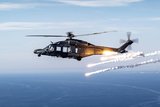
An EA-18G Growler from VAQ-133 launches from USS Abraham Lincoln (CVN 72) during NGJ-MB trials. (Photo: USN)
The Next Generation Jammer Mid-Band (NGJ-MB) system, developed by Raytheon (RTX) is part of a larger system that will augment and ultimately replace the legacy ALQ-99 Tactical Jamming System currently used on the EA-18G Growler.


The US Navy (USN) has declared Initial Operational capability (IOC) for the NGJ-MB after trials in the second half of 2024 of the jammer’s high-end capabilities during Abraham Lincoln Carrier Strike Group’s five-month deployment.
The system will be used on USN and Royal Australian Air Force EA-18G Growler electronic attack aircraft and has been designed to target, interrupt and attack advanced radar threats, communications, data links and non-traditional radio frequency threats.
The system reduces adversary targeting ranges, disrupts adversary kill chains and supports kinetic weapons to target. The NGJ-MB allows crews to operate effectively at extended ranges and attack multiple targets simultaneously.
Related Articles
Boeing and USN to negotiate NGJ-MB integration contract extension
Raytheon to develop Next-Gen Jammer upgrade for US navy under $192million deal
Raytheon receives $590 million for Growler jammer
The USN’s PMA-234 programme office is responsible for acquiring, delivering and sustaining electronic attack systems.
Lt Cdr Michael Bedwell, EA-18G Naval Flight Officer and NGJ-MB deputy integrated product team lead, said the system will help “maintain spectrum dominance”.
“The era of isolated surface-to-air missile systems, which operate within a non-agile and limited frequency range, is behind us,” Bedwell said.
In December 2024, the USN awarded Raytheon a US$590 million follow-on production contract for NGJ-MB. Earlier in the year, the company was awarded a $192 million contract to develop the Next-Generation Jammer Mid-Band Expansion (NGJ-MBX) – an upgrade to the NGJ-MB.
Related Equipment in Defence Insight



More from Air Warfare
-
![How the UK’s New Medium Helicopter award strengthens AW149’s European prospects]()
How the UK’s New Medium Helicopter award strengthens AW149’s European prospects
The UK advanced its long-delayed New Medium Helicopter programme in March with a £1 billion order for 23 Leonardo AW149s. While the deal could provide a foundation for further UK and European export orders, funding pressures and previous delays continue to cloud the programme’s future.
-
![UK air focus: Drone spending trails European frontline states despite $10.46 billion valuation]()
UK air focus: Drone spending trails European frontline states despite $10.46 billion valuation
Despite the UK having the third-largest military UAV market in Europe, the country appears to be underinvesting in the capability relative to the size of its economy, particularly when compared with Baltic and eastern European states.
-
![Proteus: Forging the future of autonomous rotorcraft]()
Proteus: Forging the future of autonomous rotorcraft
As the home of British helicopters, Leonardo has worked with the UK Ministry of Defence for over a decade to advance technologies underpinning uncrewed rotorcraft. Today, in partnership with UK Defence Innovation and the Royal Navy, Leonardo is spearheading the next step in that journey: from remotely piloted technologies to fully autonomous systems.
-
![“Fifth-gen capability without the cost”: how autonomous strike can change the face of air warfare]()
“Fifth-gen capability without the cost”: how autonomous strike can change the face of air warfare
In Conversation… Armor Harris, Senior Vice President for Aircraft at Shield AI, talks to Shephard’s Gerrard Cowan about why cost-effective autonomous aircraft are a game-changer for air forces worldwide, and the key roles played by VTOL and AI as enabling technologies.