US military tests AI-powered CUAS turret against drone swarms
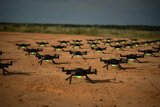
US Army drone swarm demonstration in Laoag City, Philippines. (Photo: US Army)
As the US continues to invest heavily in counter-drone systems, demand for low-cost, mobile and autonomous technologies is on the rise, with Edda designed to align with these emerging requirements.


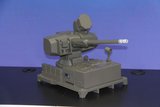
The Pentagon and its agencies are testing the Edda portable, autonomous, artificial intelligence-driven hard-kill counter-uncrewed aerial system (CUAS) turret against drone swarms. Spotter Global and 9 Mothers, the system’s suppliers, claim that it can engage drones at a cost starting at US$7 per target.
Russell Smith, CEO of 9 Mothers, told Shephard that the capability responds to requirements from the US armed services and has completed “a large number” of tests, although he could not disclose further details.
The system has been developed to protect critical infrastructure and warfighters on the move from coordinated, fast-moving, radio-silent first-person-view (FPV) uncrewed aerial
Our news & analysis is now part of Defence Insight®
A Basic-level or higher Defence Insight subscription is now required to view this content.

More from Country-focused updates
-
![US military seeks common controllers for drones and robotic systems]()
US military seeks common controllers for drones and robotic systems
US Air Force, Army, Marine Corps and Special Operations Command initiatives signal demand for interoperable uncrewed systems control, creating opportunities for suppliers of hardware, software and integration services.
-
![AUSA 2026: XM30 competitors keep their cards close as US Army decision approaches]()
AUSA 2026: XM30 competitors keep their cards close as US Army decision approaches
The US Army’s XM30 programme is an ambitious multi-billion-dollar effort to replace Bradley infantry fighting vehicles. American Rheinmetall and General Dynamics Land Systems are fighting for the contract.
-
![Anduril’s $6.6bn wager on fixing America’s submarine bottleneck]()
Anduril’s $6.6bn wager on fixing America’s submarine bottleneck
Anduril’s Arsenal-2 is a gamble on a brand-new yard and perfect timing, but with Virginia-class output stuck at 1.1 to 1.2 boats a year, it is a bet worth making.
-
![US Coast Guard faces key procurement decisions after C-130J and MQ-9B orders]()
US Coast Guard faces key procurement decisions after C-130J and MQ-9B orders
The service is updating several parts of its aviation fleet including fixed-wing and rotary-wing aircraft and procuring uncrewed aircraft to boost its maritime surveillance.
-
![Canada targets 2027 frigate trials for CU179 Peregrine uncrewed helicopter]()
Canada targets 2027 frigate trials for CU179 Peregrine uncrewed helicopter
The Royal Canadian Navy’s CU179 Peregrine will undergo Halifax-class frigate trials in 2027 ahead of initial operational capability in 2028, while River-class destroyer integration arrangements remain undefined.
-
![Singapore confirms fully automated SIGMA SPH as new precision-strike system emerges]()
Singapore confirms fully automated SIGMA SPH as new precision-strike system emerges
Singapore has confirmed plans to introduce a fully automated howitzer alongside an emerging precision-strike capability whose weapon type and deployment status have not been disclosed.