US Air Force to add new capabilities to its in-service and future T-7A fleet
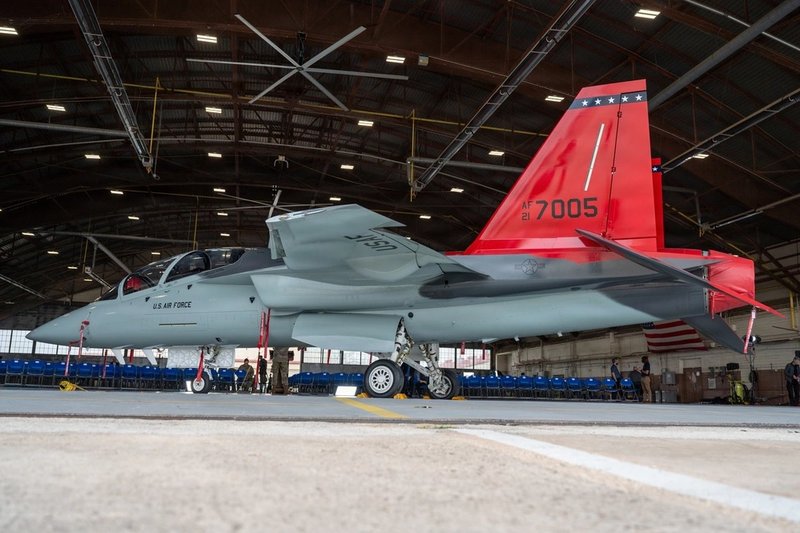
A T-7A Red Hawk departs Edwards Air Force Base, California. (Photo: US Air Force)
As the T-7A programme recovers from delays and rising costs, the USAF is signalling new opportunities in anti-jamming GPS, collision avoidance, advanced flight controls and pilot interface improvements.


The US Air Force (USAF) is preparing to modernise its Boeing T-7A Red Hawk fleet from FY2029 and is now seeking suppliers of solutions to improve navigation, safety and survivability for both the in-service and future aircraft.
The service’s Materiel Command is currently conducting market research to identify potential terrain and air collision avoidance capabilities, solutions to support landing emergencies and advanced flight control features. It is also pursuing an embedded GPS/INS (EGI) system to enhance accuracy and provide anti-jamming/GPS signal retention capabilities in addition to sensors and technologies to upgrade the pilot vehicle interface (PVI).
Due on 30 July, the Sources Sought Notice (SSN) stated that this effort will require contractors to provide “competency in information assurance, cybersecurity, software, avionics, operational safety and suitability”.
Related Articles
US Air Force conducts climate testing with the T-7A Red Hawk
Boeing’s T-7A poised to meet UK fast jet trainer requirements
Additional delays might hit Pentagon’s critical air programmes, GAO warns
According to the SSN, the USAF also expects vendors to offer a “robust supply chain management system for parts support” and technical and management infrastructure to manage product development, testing, production and retrofitting.
The information gathered in market research will inform acquisition strategies and assist the air force in determining whether it will conduct a full and open competition or a sole source purchase.
The T-7 will replace the Northrop Grumman T-38 Talon, which was introduced into service in 1961. Last manufactured in 1972, more than 500 units of this trainer remain in operation with the USAF.
The GAO Weapon Systems Annual Assessment noted that the T-7A “seeks to address the Air Force’s advanced fighter pilot training needs and close training gaps that the T-38C cannot fully address”.
The USAF Materiel Command, in turn, noted that the T-7A is “a purpose-built, single-engine, high-performance jet aircraft, matching ground-based training system, support equipment, required courseware, and other necessary systems best supported the needs of the Air Force”.
The new system is intended to equip training bases and test locations of the branch’s Air Education and Training Command. The total acquisition goal for the programme consists of 351 aircraft.
Obstacles to field the T-7A
Revealed in 2021, the T-7 procurement has experienced multiple issues and is currently behind its initial planning according to the GAO.
The programme recorded delays caused by the need for additional engineering analysis and longer software development in addition to problems with the aircraft escape system and projector. Other obstacles impacting its schedule included lower-than-anticipated aircraft availability, maintenance issues and lack of spare parts.
Moreover, the initiative also faces financial problems as its estimated total acquisition cost increased by 11%, from US$8.8 billion to $9.7 billion between its first outline and 2025.
The trainer was set to be in first production last year. Nevertheless, on 16 January 2025, the air force postponed its manufacturing until 2026 despite having four Production Representative Test Vehicles (PRTVs) set to be procured in the period.
The T-7 initiative is presently entering the low-rate initial production phase after having an approved Milestone C decision. In May, the USAF awarded Boeing a $219 million contract for the first 14 aircraft.
The GAO stated that the programme will complete developmental testing of initial capabilities in the summer of 2027 and operational testing of initial capabilities by April 2028.
“However, testing for a system-level integrated prototype, which will include linking the Ground Based Training System with the aircraft in flight, is not expected until July 2027—nearly 18 months after the production decision and nearly three years later than originally planned,” the office claimed in its report.
Shephard’s Farnborough International Airshow coverage is sponsored by MBDA

Related Programmes in Defence Insight
Related Equipment in Defence Insight

More from Farnborough International Airshow 2026 | View all news
-
![“Fifth-gen capability without the cost”: how autonomous strike can change the face of air warfare]()
“Fifth-gen capability without the cost”: how autonomous strike can change the face of air warfare
In Conversation… Armor Harris, Senior Vice President for Aircraft at Shield AI, talks to Shephard’s Gerrard Cowan about why cost-effective autonomous aircraft are a game-changer for air forces worldwide, and the key roles played by VTOL and AI as enabling technologies.
-
![How AI is reshaping defence procurement through sustainment]()
How AI is reshaping defence procurement through sustainment
Artificial intelligence is not just changing how defence equipment is maintained but how defence programmes are won, creating new opportunities for industry by influencing acquisition decisions and shaping competition.
-
![Ukraine experience forces rethink of counter-UAS doctrine]()
Ukraine experience forces rethink of counter-UAS doctrine
A panel session at Eurosatory 2026 brought together industry, academia and the French armed forces to assess how Ukraine’s battlefield reality is reshaping counter-UAS (CUAS) technology, air defence doctrine and Western procurement priorities.
-
![NATO’s GlobalEye selection reflects a move towards greater European defence autonomy]()
NATO’s GlobalEye selection reflects a move towards greater European defence autonomy
The joint acquisition of Saab’s GlobalEye AEW&C aircraft by 11 allies marks the end of NATO’s more than four-decade reliance on a US-built airborne early warning platform.