Northrop Grumman demonstrates deep-sensing platform at EDGE 23
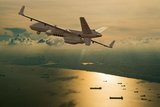
Northrop Grumman's DSaT is installed on a CRJ-700. (Photo: Northrop Grumman)
Northrop Grumman successfully showcased its Deep-Sensing and Targeting (DSaT) platform at the US Army’s Experimental Demonstration Gateway Event 2023 (EDGE 23) event.


The company said in a statement that during a simulated, real-world tactical scenario earlier this year, the system successfully gathered and fused multi-domain data for rapid dissemination to the Tactical Operations Center, collected and analysed data from commercial satellites using systems on board the aircraft and met all of the criteria for the experimentation.
DSaT is a multi-domain deep-sensing architecture integrated into a civilian aircraft, in this case a CRJ-700, providing intelligence collection that reaches beyond the visual LoS of local sensors.
While leveraging elements of the Tactical Intelligence Targeting Access Node pre-prototype system, its capability fills a gap in data collection by combining space-based geospatial intelligence (GEOINT) imagery with aerial and terrestrial intelligence from commercial and military space systems.
Phase 1 successfully demonstrated the GEOINT capabilities with future phases planned incorporating multiple intelligence platforms.
EDGE 23 was designed to test and evaluate new technologies and more than 80 were considered at this year’s event.
As part of the event UVision USA demonstrated the successful launch of its Hero 120 loitering munition from an airborne helicopter. The trial established the system’s ability to complete a sensor-to-shooter cycle by launching the Hero 120 from a Bell 412EP helicopter and strike a ground target.
The event also saw Logos Technologies, a subsidiary of Elbit Systems of America, fly its BlackKite IR wide-area motion imagery pod on a US Army UAS for the first time.


More from Air Warfare
-
![V-22 Osprey safety upgrade moves towards wider fleet installation under $35.5 million deal]()
V-22 Osprey safety upgrade moves towards wider fleet installation under $35.5 million deal
Bell Boeing will supply 73 additional ODSSHI kits as NAVAIR prepares to introduce predictive drive-system monitoring across US and Japanese V-22 fleets.
-
![AFA 2026: USAF examines uncrewed cargo aircraft for contested logistics]()
AFA 2026: USAF examines uncrewed cargo aircraft for contested logistics
The US Air Force is evaluating demonstrators for uncrewed cargo missions as it considers logistics requirements across the Pacific and other contested environments.
-
![Germany air focus: Europe’s leading near-term air market targets domestic industry]()
Germany air focus: Europe’s leading near-term air market targets domestic industry
Between 2026 and 2032, almost a quarter of EU aircraft spending is expected to come from Germany. While crewed programmes seek modernisation and replacement, uncrewed opportunities look to introduce entirely new capabilities, with both highlighting sovereignty and domestic production.
-
![Europe risks losing control of CUAS production capacity as manufacturers look abroad]()
Europe risks losing control of CUAS production capacity as manufacturers look abroad
European counter-drone developers are securing early orders in the Middle East while slow domestic acquisition processes threaten to redirect production capacity, expertise and investment away from Europe.
-
![India’s rotary-wing capability gap grows as IMRH programme delays persist]()
India’s rotary-wing capability gap grows as IMRH programme delays persist
With IMRH and DBMRH potentially years from service, India faces a widening rotary-wing capability gap that could drive further foreign purchases even as HAL and Safran build the foundations of an indigenous successor.
-
![AFA 2026: Swarm Aero eyes 2027 Gamera flight as Textron/Merlin reveal SkyCourier UX]()
AFA 2026: Swarm Aero eyes 2027 Gamera flight as Textron/Merlin reveal SkyCourier UX
Two new uncrewed aircraft concepts target very different US military requirements, from massed long-range strike to autonomous logistics. Shephard spoke with executives from Swarm Aero, Textron Aviation and Merlin Labs at this year's AFA Air, Space & Cyber conference to learn more about their capabilities.