Kilgore and Armtec to supply US and allies with infrared flare countermeasures
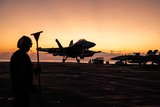
F-35 dispensing flares. (Photo: USAF/Capt Kip Sumner)
MJU-61A/B flares will be provided to the USAF and five FMS customers.


Kilgore Flares and Armtec Countermeasures have obtained a $225 million IDIQ contract to manufacture IR flare countermeasures for the USAF and FMS customers, the DoD revealed on 30 August.
The two companies will produce MJU-61A/B aircraft-launched flares over a five-year ordering period with no options.
As well as USAF budget funds, the contract includes FMS purchases for South Korea (34%), Denmark (14%), Japan (5%), the Netherlands and Italy (1% each).
The MJU-61A/B decoy flare is launched from an MJU-33/A multiple flare magazine, which is installed on a D-49/ALE-47 dispenser to decoy IR heat-seeking missiles.
The flare can be dispensed by a wide range of aircraft such as the F-35 Lightning II.


More from Air Warfare
-
![Europe risks losing control of CUAS production capacity as manufacturers look abroad]()
Europe risks losing control of CUAS production capacity as manufacturers look abroad
European counter-drone developers are securing early orders in the Middle East while slow domestic acquisition processes threaten to redirect production capacity, expertise and investment away from Europe.
-
![India’s rotary-wing capability gap grows as IMRH programme delays persist]()
India’s rotary-wing capability gap grows as IMRH programme delays persist
With IMRH and DBMRH potentially years from service, India faces a widening rotary-wing capability gap that could drive further foreign purchases even as HAL and Safran build the foundations of an indigenous successor.
-
![AFA 2026: Swarm Aero eyes 2027 Gamera flight as Textron/Merlin reveal SkyCourier UX]()
AFA 2026: Swarm Aero eyes 2027 Gamera flight as Textron/Merlin reveal SkyCourier UX
Two new uncrewed aircraft concepts target very different US military requirements, from massed long-range strike to autonomous logistics. Shephard spoke with executives from Swarm Aero, Textron Aviation and Merlin Labs at this year's AFA Air, Space and Cyber conference to learn more about their capabilities.
-
![US Navy moves EA-18G Growler Block II electronic-attack upgrade into full-rate production]()
US Navy moves EA-18G Growler Block II electronic-attack upgrade into full-rate production
A US$184.25 million contract for Next Generation Electronic Attack Units advances the Growler’s modernisation as the US Navy confronts ageing systems, parts shortages and obsolescence.
-
![Could the next UAS market boom take place beyond the battlefield?]()
Could the next UAS market boom take place beyond the battlefield?
While the headlines remain dominated by the use of drones for combat operations in Ukraine and other conflicts, there are emerging use cases where the technology could usefully feed back into areas and missions outside the war zone.