“A dominant force”: empowering Europe’s airborne ISR in a new era
European militaries face a new security landscape, with the proliferation of drones, theatre ballistic missiles and other threats boosting requirements for airborne intelligence, surveillance and reconnaissance (ISR) and related systems. For L3Harris, missionised business jets are central to meeting these needs, providing capability and flexibility in a cost-effective package.


This In Conversation interview is brought to you by Shephard in partnership with L3Harris Technologies.
The conflicts in Ukraine, Iran and beyond have brought about significant changes in the modern battlespace, particularly through the deployment of huge volumes of cheap, mass-produced UAS. The expanding range of hostile effectors means airborne early warning and control (AEW&C) and ISR capabilities must detect, track, and orchestrate the engagement of a surging volume of threats, all without any blind spots.
This rapid evolution means NATO nations “cannot wait to bolster their ISR suites – they need the strongest possible capabilities today,” according to Jason Lambert, President – ISR at L3Harris.
Missionised business jets are key to meeting these requirements, providing advantages in capability, sustainability, cost and more.
How demand is growing
Business jet missionisation has long been a focus for L3Harris, with the company integrating bespoke solutions on platforms of all sizes from manufacturers such as Boeing, Bombardier, Dassault and Gulfstream.
This work has involved mission system design, modernising the aircraft to integrate ISR solutions, radar, electronic warfare (EW) capabilities and beyond. Major programmes include the US Army’s Theater Level High-Altitude Expeditionary Next Airborne ISR-Radar (ATHENA-R) programme, built around the Bombardier Global 6500 aircraft.
The Gulfstream G550 is also the basis for a range of successful programmes, including the Royal Australian Air Force (RAAF) MC-55A Peregrine and the Italian Air Force’s Joint Airborne Multi-Mission, Multi-Sensor System (JAMMS). It also forms the basis of the EA-37B Compass Call EW platform, which has seen growing demand in the US and around the globe, with Italy the first international customer under a deal announced in July 2025.
And demand is expanding all the time. L3Harris’ next-generation AERIS X AEW&C family – which features capabilities such as an advanced AESA radar and next-generation communications suite – has seen growing interest from customers around the world, with the Republic of Korea Air Force recently acquiring the AERIS X system integrated with the Bombardier Global 6500. A second variant, the AERIS A, is based on the Gulfstream G550 platform.
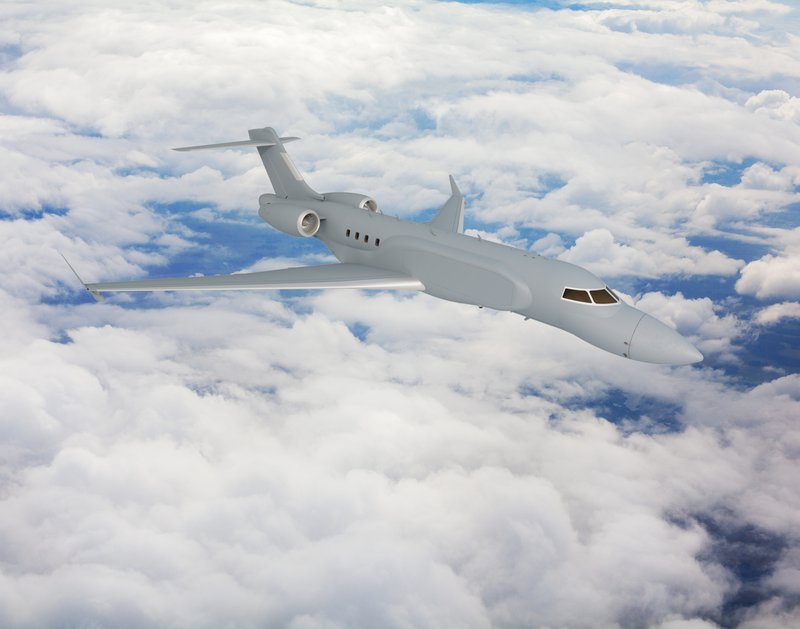
Above: Artist rendering of L3Harris’ AERIS X next-generation airborne early warning and control solution.
The benefits of business jets
The missionised business jet offers a range of advantages for military customers seeking to expand their airborne ISR capabilities, explained Lambert. First, the capability is built into an aircraft that already has commercial certification, creating advantages in both time and costs.
L3Harris conducts modifications as required - for example, the EA-37B Compass Call involves modifying the outer mold line (OML) of the aircraft and adding side cheeks to hold customised electronic capabilities.
There is then a need for a further hybrid certification process, said Lambert, combining military certifications and civilian supplemental type certificates for different configurations or interior components. Even so, the process is speedy because “rather than starting from scratch, we begin with an existing platform.”
Secondly, by partnering with leading specialist airframers such as Bombardier or Gulfstream, it means “we’re working with companies that have a global supply chain”. They are therefore set up to offer a 24/7 aircraft on ground (AOG) maintenance service or provide materials and parts rapidly, quickly addressing any technical issues.
And perhaps most importantly, Lambert emphasised the capability of business jets, notably in terms of altitude performance, with platforms like the Global 6500 capable of flying well above 40,000 feet, combining this with impressive speed and range.
“Whether it’s an ISR mission, an electronic attack mission, or an airborne early warning and control mission, that altitude advantage is substantial, particularly if you’re working in an area that’s got mountainous terrain. You need that altitude advantage,” Lambert emphasised.
Likewise, the platforms offer significant benefits in terms of size, weight and power (SWAP). “Business jets are smaller than typical military platforms. That impacts the weight and centre of gravity, as well as the power draw,” he noted.
By expanding ISR, EW and AEW&C capabilities at relatively low SWAP and cost levels, missionised business jets have a material impact on the effectiveness of militaries around the world, including in forward-deployed locations, explained Lambert.
“These aircraft enable the successful performance of other aircraft, whether that’s search and rescue missions, air defence missions, and strike packages. Whatever the mission may be, they’re enabling safe access for those mission sets. They’re true force multipliers.”
Meeting new European needs
It is no surprise, then, that missionised business jets are seeing growing demand in Europe as countries in the region adjust to a changing security landscape.
L3Harris has long worked with NATO allies on the continent, noted Lambert, pointing out that many of the capabilities in missionised business jets stem from the legacy of the US Air Force’s RC-135 Rivet Joint programme. A version of this platform is now in service with the UK Royal Air Force as the Airseeker electronic surveillance aircraft.
The success of JAMMS and EA-37B Compass Call in Italy is a mark of this growing European interest, he added. Likewise, the AERIS family has several potential customers in Europe, Lambert said, although he could not provide further details due to business confidentiality. Similarly, he noted that the company had responded to a NATO RFI on future AEW&C solutions “and we think the AERIS X is very well positioned.”
European militaries, like their counterparts in Australia, South Korea, Japan and beyond, must weigh up a range of factors when making procurement decisions on their future AEW&C capabilities, noted Lambert. Technical capability is clearly the highest priority, he said, notably the range and coverage of the radar.
Additionally, he pointed to the ability to process intelligence on board the aircraft, noting that technical advances now mean that systems can handle far more data points than in previous generations, notably through the integration of artificial intelligence (AI) on crew workstations.

Above: Artist rendering of L3Harris’ AERIS X next-generation airborne early warning and control solution.
Providing national sovereignty
The manufacturing process and overall industrial package is also a vital consideration. L3Harris partners with OEMs and mission systems providers such as BAE Systems and Israel Aerospace Industries ELTA Systems to deliver the capabilities customers require quickly.
For instance, Lambert said that on the US ATHENA-R programme, L3Harris and its partner MAG Aerospace needed to develop a distinctive “canoe”-style fairing underneath the forward fuselage to hold the synthetic aperture radar. This integration work was accomplished by L3Harris at our Waco and Greenville, Texas, facilities, and in 18 months, we modified the OML shape of a green aircraft and fully integrated the mission system, he noted.
Such rapid development will be essential for European militaries and the NATO alliance as they adapt to a quickly evolving battlespace: “They don’t need to wait until 2035 for the next system to be ready. They need something far sooner than that. Being able to deliver capability quickly is what we’re all about.”
In addition, the dynamic threat picture means industry providers must be capable of upgrading the aircraft as needed in terms of both hardware and software – and do it rapidly.
Lambert pointed to the company’s emphasis on “quick release”, providing spiral upgrades to respond to emerging threats as required.
This is a core focus for L3Harris’ facility in Greenville, Texas, which provides a range of services for both the US military and its allies, including the UK’s Airseeker programme.
For instance, the company provides a Multi-Sensor Test Facility (MSTF) at the site, meaning any customer can immediately tune their system for new needs as soon as they develop.
“That is incredibly unique. It’s all about speed, it’s all about relevancy, and it’s all about domination of the information and electromagnetic space worldwide.”
Crucially, the company also offers such capabilities to its customers in their own countries or regions, Lambert added, with an emphasis on national sovereignty and partnering with local industry. He pointed to its policy in South Korea of “Korean-made, Korean-operated and Korean-maintained”, based on its partnership with Korean Air.
L3Harris is taking a similar approach in Italy, he said, for JAMMS and EA-37B Compass Call, which will involve building a local MSTF with partner ELT Group. While this will be located in Italy, it could also be used by other European operators, he added.
Achieving future dominance
As European militaries and their allies look to the future battlespace, multi-domain capability will be key, noted Lambert. This means AEW&C, airborne ISR and EW must be placed in the context of other domains, a significant focus for L3Harris.
Such connectivity will be vital to address the sheer volume of the threat from drones and missiles, as well as their growing range. This will require a wide-ranging response, he noted, combining the different mission systems.
“It can’t just be a ground operation or space operation. The air domain contains a key part of that response: it’s really a multi-domain approach.”
The key to meeting this challenge is dominating the electromagnetic spectrum, he concluded. By delivering significant advantages in affordability, sustainment, and capability, missionised business jets will play a crucial role in enabling European militaries to meet the challenges of the modern battlespace.
“The collaboration of ISR, AEW&C and electronic attack will enable them to be a dominant force to ensure the good guys are winning, because we don’t want the alternative,” Lambert concluded.
Learn more at L3Harris.com



More from Industry Spotlights
-
![With a wave of upgrades, the MQ-9B is ready for high-tech warfare]()
With a wave of upgrades, the MQ-9B is ready for high-tech warfare
The modern battlefield is evolving rapidly — threats range from stealthy cruise missiles to coordinated drone swarms. General Atomics Aeronautical Systems, Inc. (GA-ASI) is meeting these challenges head-on with a series of transformative upgrades to its MQ-9B SkyGuardian® and maritime SeaGuardian® remotely piloted aircraft.
-
![The speed of relevance: how companies can navigate the new era of European defence procurement]()
The speed of relevance: how companies can navigate the new era of European defence procurement
European militaries face a rapidly evolving security landscape and defence production must accelerate to meet surging demand for platforms and equipment. Industry needs to adapt to ensure it gets its products into the hands of the end user, Evelyn Rafferty, Senior Director Aerospace and Defence - Europe at Plexus told Shephard’s Gerrard Cowan.
-
![Patria TRACKX: Designed to conquer the most challenging environments]()
Patria TRACKX: Designed to conquer the most challenging environments
The tracked all-terrain armoured vehicle Patria TRACKX is a promise of performance. It is engineered to navigate the toughest terrain silently and swiftly, ensuring smooth operations in any conditions.
-
![“A staggering rate of change”: how experience combating IEDs is being applied to the C-UAS arena]()
“A staggering rate of change”: how experience combating IEDs is being applied to the C-UAS arena
The scale of the current escalation in drone attacks is fuelling demand for C-UAS technology that must address a rapidly evolving and expanding threat. Against this background, important lessons can be learned from the battle against IEDs, with networked responses and dispersed capabilities essential to deliver enduring protection.
-
![Agile, sovereign, edge-ready: rewiring defence IT for a contested decade]()
Agile, sovereign, edge-ready: rewiring defence IT for a contested decade
Today's rapidly changing security landscape means that armed forces can no longer treat their data in the same way as in the past. What are the key challenges they face, and how can industry help them?
-
![The science of soldier safety: How Team Wendy Is reinventing the modern military helmet]()
The science of soldier safety: How Team Wendy Is reinventing the modern military helmet
When soldiers head into the field, the helmet on their head can mean the difference between life and death. But while helmets may look simple from the outside, the technology inside them is anything but. Few companies illustrate this better than Team Wendy, whose newest bump helmet — the RECON™ Tactical — shows just how far modern head protection has come.