Open menu Search

FIA 2026: BAE unveils Brontanax for British and international CCA requirements

22nd July 2026 - 14:02 GMT | by Matty Todhunter in Farnborough, UK

RSS

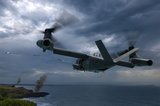
Flight trials of the new system are planned for the second half of 2027. (Photo: author)

Designed for the UK Royal Air Force’s StormFighter requirement, the carrier-capable platform could also support Royal Navy operations and international customers within the estimated $77.08 billion air force CCA market.

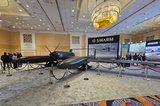
On Wednesday morning at the Farnborough International Airshow 2026, BAE Systems unveiled Brontanax, the UK’s first fully sovereign collaborative combat aircraft (CCA), which is scheduled to fly in 2027. The drone is BAE’s answer to the UK’s StormFighter CCA requirement, with its name – which in Ancient Greek means “thunder” – exemplifying the link.

The aggressive flight timeline underscores the Royal Air Force’s (RAF) determination to become “Europe’s first 6th Generation Air Force”, an ambition highlighted by Air Staff Air Marshal Sir Harv Smyth at the drone’s unveiling. To achieve this would require a sixth-generation formation to be fielded before 2030.

Speaking to journalists following the unveiling, FalconWorks managing director Dave Holmes provided more information on Brontanax’s timeline. He noted that power-on is planned for Q3 2026, followed by ground trials in the first half of 2027, before the planned flight trials in the second half of the year. The flight trials are planned for the NATO Steadfast Defender 27 exercise, with the drone paired with the Typhoon crewed fighter.

June drone digest: Landmark CCA contract and deep-strike capability flourishes at Eurosatory

UK air focus: Drone spending trails European frontline states despite $10.46 billion valuation

The aircraft’s development began in 2022 and is no doubt a continuation of the Concept 2 platform BAE demonstrated at DSEI 2023. The system, now evolved into Brontanax, is the newest contender in an ever-growing CCA market, with Defence Insight valuing the air force component alone at US$77.08 billion. 

Nations are launching procurements for such a capability because, as highlighted by Simon Barnes, group managing director of BAE Systems’ Air sector, these types of aircraft will “provide the ability to extend the reach of crewed aircraft, generating greater combat mass at lower cost, while keeping pilots out of harm’s way”. 

Sovereignty of StormFighter

BAE’s pitch of Brontanax for the UK’s StormFighter CCA programme, which was formally named as such last week, centres on one overriding theme: sovereignty. This is the “key differentiator”, according to Holmes, who confirmed that BAE had reached out to “nearly 100 UK-based companies” and had drawn in new companies from near-neighbour industries to help secure its sovereign supply chain. 

Holmes noted that this supply chain, and BAE itself at its Warton, Lancashire facility, has the capacity – if acquired – to produce the volume any UK CCA procurement would require. Other benefits of Brontanax compared to other CCAs, he claimed, included its “payload base”, endurance and survivability.

BAE will be hoping these differentiators will help it satisfy the RAF’s open requirement, which emerged from the now-cancelled Project Mosquito. The effort received $300 million in funding between FY2026 and FY2030 in last month’s UK Defence Investment Plan (DIP), with Defence Insight estimating the entire programme value at $3.19 billion.

The DIP also highlighted that StormFighter will “exploit a sovereign, world-leading propulsion system”, which many at the time, including Shephard, believed would be Rolls-Royce. For Brontanax, this is the case, with Holmes revealing that BAE was working with the British firm, which was confident it could scale up its current developments to meet the thrust and price requirements of BAE’s new aircraft.

Regarding the size of a StormFighter formation, media displayed at the unveiling event showcased four Brontanax for each crewed fighter, suggesting this would be the size and composition of the RAF’s sixth-generation fighter formation. When asked to confirm this, however, Sir Gerry Mayhew, senior military adviser for BAE Systems, said the “four-to-one ratio is indicative only”, and that any formation size was as much “about the advancement of Typhoon” as the CCAs that would accompany it.

Customers at sea and abroad

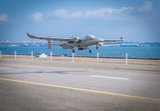
The RAF is not the only potential customer; BAE is also eyeing the UK Royal Navy (RN) as a Brontanax user, confirming to the press that the system is carrier-capable. Holmes confirmed BAE had conducted extensive carrier integration simulations and a modified version of Brontanax could “meet the requirements for launch and recovery off the carrier” without the need for a catapult or “duplicate production lines”.

The ability of CCAs to conduct non-catapult, short takeoff and landing (STOL) operations from their Queen Elizabeth-class carriers is a key requirement for the RN, which, through Project Vanquish, is currently developing and testing these capabilities to inform a potential future procurement programme that Defence Insight estimates to be worth $960 million.

As much as BAE sees itself as, in Holmes’ words, a “sovereign provider” to the UK’s CCA requirements in air and at sea, Brontanax is also pitched at the country’s allies. 

Barnes expanded on this sentiment, confirming that export to international customers was a “big part of the market proposition” for Brontanax, with many Typhoon and non-Typhoon users reportedly interested in the platform.

Indeed, the platform’s modularity is designed to play into this international appeal, as it will allow international customers to “bring their own indigenous packages”, which Holmes highlighted as a “prerequisite” for many nations importing a drone of this type.

For example, the UAE has done this with the purchase of many of its medium-altitude long-endurance (MALE) drones, equipping its domestic Desert Sting 16 (DS-16) precision-guided munition on the 20 Bayraktar TB2 aircraft that it acquired in 2022, and is very likely to do the same should it acquire the American MQ-9B.

Paired systems

The unveiling of Brontanax and its role alongside a crewed counterpart underscores the future of the Typhoon as a critical capability for the RAF, as outlined by Isolde Hatgis-Kessel, air analyst at Shephard.

During a Typhoon briefing on 21 July at Farnborough, BAE leadership confirmed they expect the Typhoon to remain in service well past the original 2040 out-of-service date. 

As the Global Combat Air Programme is not scheduled to be operational until halfway through the next decade, assuming the project does not face any delays, introducing a new CCA alongside the Typhoon will ensure that Britain’s air force remains competitive.

The UK could be moving towards a two-tier crewed-uncrewed teaming approach. Holmes indicated that Brontanax’s payload bay could host systems like Blizzard, a newly named decoy and suppression effector unveiled at DSEI 2025 which is being produced by BAE Systems’ FalconWorks in collaboration with Lockheed Martin’s Skunk Works.

This formation structure would vastly increase the combat effectiveness of a single fighter, which is the core goal of all CCA programmes. Additionally, regarding sub-systems, Holmes confirmed that the drone is compatible with all current weapons in service with the RAF.

Shephard’s Farnborough International Airshow coverage is sponsored by MBDA

MBDA

StormFighter [UK]

Autonomous Collaboration Platform (ACP) (Project Vanquish) [UK]

Eurofighter Typhoon Tranche 3A (Block 20, 25, 25C)

Autonomous Collaborative Platform (ACP) (Concept 2)

Matty Todhunter

Author

Matty Todhunter


Matty Todhunter is the Air Desk Lead & Senior UAV Analyst for Defence Insight. He won …

Read full bio

Share to

Linkedin