Details revealed on new UAS munition destined for Ukraine
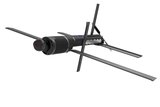
The twin x-wing platform has a length of 1.12m. (Photo: Helsing)
Helsing’s HX-2 has a weight of 12kg and a range of 100km. It is planned to enter service in Ukraine in 2025.


German artificial intelligence (AI) and drone company Helsing has released details on its HX-2 attack uncrewed aerial system (UAS) which is set to be deployed in Ukraine where underlying technology of the system is already in use.
The platform is described by the company as “software-based, mass-producible and swarm-capable, electrically-propelled, twin x-wing-precision munition with up to 100 km range”.
The platform has weight of 12kg with a warhead payload of 4.5kg and a maximum speed of 250kmh. Propellers are mounted on the rear x-wings and the UAS has a length of 1.12m.
Related Articles
Defence AI company Helsing envisions benefits for ASW, amplifying sensor capabilities
Germany adds AI backbone to FCAS next-generation fighter jet
Saab partners with Helsing to get AI on Gripen E aircraft
A key feature of the system is an on-board computer which runs the AI component. Combined with stored map data, it allows for operation in satellite- or GPS-denied environments. Navigation is provided by the platform identifying landmarks.
When operating as part of Helsing’s Altra recce/strike software, multiple HX-2s can assemble into swarms controlled by one operator.
It is designed to be mass-producible and at unit cost less than conventional systems. Helsing is ramping up production in Europe with first deliveries to Ukraine expected in early 2025.
In announcing the UAS the company repeatedly highlighted the platforms use in Ukraine and with one operational scenario “being deployed along borders at scale, HX-2 can serve as a powerful counter invasion shield against enemy land forces”.
Additionally, “NATO urgently requires technology to protect the integrity of the Eastern Flank [and] we’ve invested to develop this capability and give NATO an edge through precision mass”.
In February last year the company announced it was opening a headquarters in the UK. The UK Ministry of Defence noted this was part of a plan to mass-produce thousands of a new AI-enabled UAS over the next five years within a £350 million (US$442 million) investment.
Related Programmes in Defence Insight
Related Equipment in Defence Insight


More from Air Warfare
-
![Eurosatory 2026: Helicopters and CUAS set to dominate as Europe advances rearmament efforts]()
Eurosatory 2026: Helicopters and CUAS set to dominate as Europe advances rearmament efforts
The biennial show in Paris will focus heavily on autonomous technology, counter-drone solutions and helicopters, as countries ramp up defence budgets and focus on modernising defence capabilities.
-
![North American appetite for European AEW&C aircraft bolstered as Canada picks GlobalEye]()
North American appetite for European AEW&C aircraft bolstered as Canada picks GlobalEye
Canada’s selection of Saab’s GlobalEye to fulfil its airborne early warning requirements draws the country closer to European industry over American-made platforms, snubbing Boeing and L3Harris.
-
![US Air Force to fast-track capability development for GPS-denied operations]()
US Air Force to fast-track capability development for GPS-denied operations
Over the next 18 months, the air force's research facility intends to accelerate the progress of resilient, autonomous solutions to support aircraft and helicopter deployments in DDIL overland and over-the-water scenarios.
-
![May drone digest: American loitering munition spending continues to drive market growth]()
May drone digest: American loitering munition spending continues to drive market growth
Loitering munition procurement has accelerated throughout May 2026 as militaries continue to prioritise the capability. The US has led this activity by advancing swarm-drone concepts, downselecting more drones for the Army’s LASSO programme, and awarding procurement contracts for various systems.