Airbus Helicopters is deepening its European reach as NATO orders climb
The H225M transport and heavy-lift helicopter is operated by 19 countries. (Photo: Airbus)
Airbus has delivered more than 2,000 helicopters to nations across Europe, and continues to solidify its position at the heart of the region’s defence industrial base.


Airbus is a major player in the European aerospace and defence sector, and its helicopter segment has been gaining a stronger strategic foothold in key NATO nations as it expands eastward in the region, with a surge in order numbers over the past year.
The company has four primary production plants across Europe – two in Germany and two in France – offering the continent critical manufacturing capabilities.
With a helicopter portfolio that spans multi-role, transport and heavy lift, along with light attack rotorcrafts, Airbus Helicopters has so far delivered more than 5,000 platforms globally, with approximately 2,276 helicopters delivered across 20 European nations alone.
Related Articles
Germany acquires additional 20 H145M helicopters
Singapore Airshow 2026: Airbus-RSAF H225M teaming tests point to future scalability
One critical Airbus platform is the H145/H145M. The multi-role helicopter can carry out a broad range of mission sets, including special operations, airlift, search and rescue, casevac/medevac and armed scout and light attack. This versatility combined with its low operating costs have led to the platform becoming a popular choice globally. Airbus is currently testing the platform with the Hivemind system from Shield AI, with the first autonomous flight, including take-off and landing of the H145M, completed in August 2025.
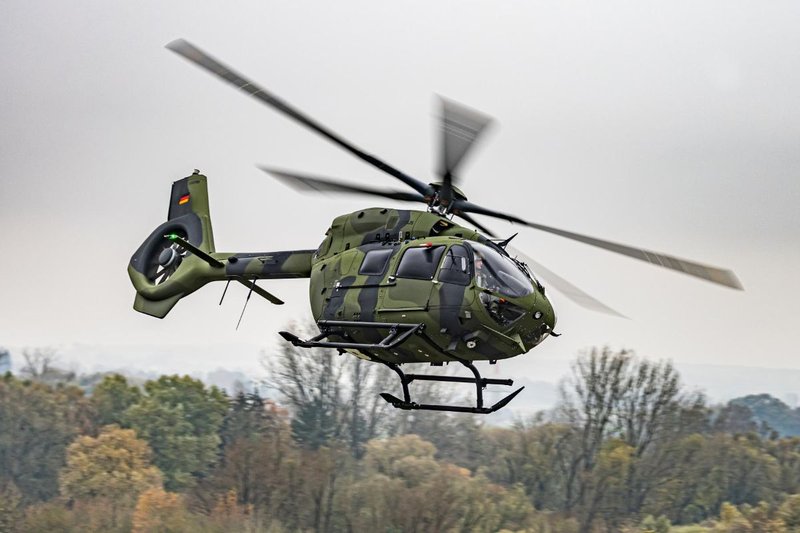
The platform has 15 operators across the Middle East, Europe and South America, with concentrated interest from Latin American nations. Reports indicate that Brazil is considering acquiring 12 H145M units, which will be domestically manufactured by Helibras. Similarly, Chile has reportedly expressed an interest in the H145 as a replacement for the Bell UH-1H.
Strengthening position on NATO eastern edge
Eastern Europe holds important market potential for Airbus’ H145M after the company signed a Memorandum of Understanding (MoU) with Hungary to build a new manufacturing site in Gyura. Hungary also procured 16 H225M platforms in 2018 for approximately US$560 million.
As Airbus put forth a bid to fulfil Poland’s requirement for an SW4 Puszczyk replacement, its existing base in Hungary could sway the selection and open new opportunities across Eastern Europe. Shephard projects that Poland’s open contract is worth approximately $274 million.
Another high-export platform produced by Airbus is the H225M, a transport and heavy-lift unit helicopter with 19 operators, including Ukraine, the UAE, Morocco and France. Since first delivery in 2005, Airbus has supplied 220 H225M units globally. The platform’s popularity is in part attributed to its weather versatility as the unit complies with FAR/JAR 29 regulations.
Airbus finalised two new contracts for the H225M in the past year. At the Dubai Air Show 2025, Morocco finalised the procurement of 10 units to replace its aged fleet of Airbus-manufactured Puma platforms. In September 2025, the Royal Thai Air Force finalised a contract for two additional units following a 2018 order worth $140 million for four H225M helicopters.
Growing European footprint
In mid-December 2025, Airbus agreed a significant contract award with four helicopter procurement contracts finalised with Spain. With 100 platforms ordered, Airbus is set to supply the Southern European nation with additional NH90 Tactical Transport Helicopters, the H145M, the H135 and the H175.
These new contracts, with the largest sitting at approximately $1.2 billion for 31 N90 TTH units, further cement the company’s footprint and future in Europe, showing a procurement logic that increasingly favours continuity over diversification.
The European defence industrial base
Airbus represents a core component of the European defence industrial base, resulting from its long-standing reputation and extensive installed bases across Europe and other regions.
As the region looks inwards to strengthen its defence capabilities, Airbus is likely to be an important factor of long-term stability. The company’s existing presence across the continent is often viewed as an incentive for European states to continue to work with Airbus, including expanding inventory where necessary or acquiring new platforms.
Homogeneity across military inventory on the continent can increase interoperability and preparedness. Further to this, future procurements in the next two decades to replace existing, aged fleets could see a preference towards Airbus platforms to avoid high switching costs, including retraining pilots and reorienting doctrine that has been, in part, based around these units.
Airbus’s platforms could be a key opportunity for Europe to enhance its position as a global supplier of defence technologies and military equipment. Following themes from Davos last month, as middle powers seek to diversify partnerships, Airbus is likely to remain a central presence as countries harness the company’s portfolio into national and international strategy.
Related Programmes in Defence Insight
SW4 Puszczyk Replacement [Poland]
Related Equipment in Defence Insight


More from Air Warfare
-
![US Marine Corps aims to make drones as commonplace as rifles on the battlefield]()
US Marine Corps aims to make drones as commonplace as rifles on the battlefield
The USMC is transforming drones into standard equipment through major funding increases, standardised training, new doctrine and rapid battlefield adaptation, with nearly $820 million requested for UAS programmes in FY2027.
-
![FIA 2026: Malloy eyes NATO expansion and Australia for T-150 as it scales up technology]()
FIA 2026: Malloy eyes NATO expansion and Australia for T-150 as it scales up technology
BAE Systems’ Malloy Aeronautics is seeking to expand the international customer base for its T-150 heavy-lift UAV, with NATO users beginning to adopt the platform and Australia identified as a key prospective market.
-
![FIA 2026: Embraer, Anduril sign agreement to develop cruise missile launch capability for the C-390]()
FIA 2026: Embraer, Anduril sign agreement to develop cruise missile launch capability for the C-390
The Brazilian airframer and US developer have announced plans to offer a palletised launch system for the twinjet tactical airlifter.
-
![FIA 2026: Tekever targets British Army’s Project Nyx with hydraulic-powered AR6 drone]()
FIA 2026: Tekever targets British Army’s Project Nyx with hydraulic-powered AR6 drone
As Tekever positions its newly revealed UK-sovereign, autonomous heavy-lift drone family for the British Army's Project Nyx, the company is also eyeing an international future for the capability.
-
![FIA 2026: Boeing pitches Ghost Bat as mature answer to growing CCA demand]()
FIA 2026: Boeing pitches Ghost Bat as mature answer to growing CCA demand
Boeing said demand for collaborative combat aircraft could outstrip what any single supplier can provide, as BAE Systems and Anduril unveiled new platforms at Farnborough International Airshow 2026.