AI mission-autonomy software integration and partnerships see progress across CCA efforts
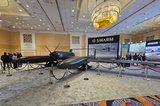
The USAF has now validated open systems architecture for use on Increment 1 CCA prototypes. (Photo: USAF)
The successful integration of third-party mission autonomy in the US Air Force’s CCA programme and movement on Helsing’s Europa CA-1 timelines mark key milestones in the development of uncrewed aerial capabilities.


Further advancement has been made towards mission autonomy integration with the US Air Force’s (USAF) Collaborative Combat Aircraft (CCA) programme, with European CCA programmes also taking steps towards autonomy integration in their uncrewed aerial vehicle (UAV) prototypes.
The USAF announced the validation of its Autonomy Government Reference Architecture (A-GRA) last week – allowing Shield AI and RTX, as the programme’s mission autonomy companies, to integrate their software via this open architecture into General Atomics Aeronautical Systems’ (GA-ASI) and Anduril’s CCA YFQ-42A and YFQ-44A prototypes.
Shield AI’s Hivemind autonomy software and RTX were reportedly selected by the USAF to support its Increment 1 CCA
Our news & analysis is now part of Defence Insight®
A Basic-level or higher Defence Insight subscription is now required to view this content.

More from Air Warfare
-
![India’s rotary-wing capability gap grows as IMRH programme delays persist]()
India’s rotary-wing capability gap grows as IMRH programme delays persist
With IMRH and DBMRH potentially years from service, India faces a widening rotary-wing capability gap that could drive further foreign purchases even as HAL and Safran build the foundations of an indigenous successor.
-
![US Navy moves EA-18G Growler Block II electronic-attack upgrade into full-rate production]()
US Navy moves EA-18G Growler Block II electronic-attack upgrade into full-rate production
A US$184.25 million contract for Next Generation Electronic Attack Units advances the Growler’s modernisation as the US Navy confronts ageing systems, parts shortages and obsolescence.
-
![Could the next UAS market boom take place beyond the battlefield?]()
Could the next UAS market boom take place beyond the battlefield?
While the headlines remain dominated by the use of drones for combat operations in Ukraine and other conflicts, there are emerging use cases where the technology could usefully feed back into areas and missions outside the war zone.