Open menu Search

Additional delays might hit Pentagon’s critical air programmes, GAO warns

10th July 2026 - 14:31 GMT | by Flavia Camargos Pereira in Kansas City, Missouri

RSS

A B-52 flies over Miami Beach, Florida. (Photo: US Air Force)

B-52 modernisation, Sentinel, MH-139A, T-7A and Air Force One replacement are among the US Air Force programmes the GAO says remain at risk of further schedule slips and cost growth due to acquisition and management challenges.

The US Government Accountability Office (GAO) has recently warned that critical US Air Force (USAF) acquisition and upgrade efforts already behind their original schedule might face additional delays and cost overruns in the coming years due to management issues and “overly optimistic timeframes”.

The list includes initiatives such as the B-52 Stratofortress Commercial Engine Replacement Programme (B-52 CERP), B-52 Radar Modernisation Programme (B-52 RMP), LGM-35A Sentinel, MH-139A Grey Wolf Helicopter, T-7 Advanced Pilot Training Programme (T-7A) and VC-25B Presidential Aircraft Recapitalisation.

According to its Weapon Systems Annual Assessment published last week, the US Department of Defense (DoD) “continues to face challenges in executing modern approaches” to conduct procurement and refresh efforts, which might impact its ability “to respond to evolving threats and to compete with countries, such as China and Russia”.

Can the US overcome Russian and Chinese nuclear capabilities?

How Chinese advancements will impact the future development of the US Air Force fleet

What does the FY2027 US budget signal for the country’s future airpower plans?

The B-52 upgrade has recorded postponements both in the Commercial Engine Replacement Programme (CERP) and the Radar Modernisation Programme (RMP). In the case of the CERP, the GAO noted that the USAF plans to establish a formal acquisition programme baseline and enter development in the third quarter of 2026.

It is “nearly two years later than planned after transitioning to the MCA [major capability acquisition] pathway in December 2023,” the report stated.

Some of the problems involved engine source selection duration, funding constraints and detailed engine and wiring design time frame. It generated a three-year delay to the critical design review and the postponement of the next cybersecurity assessment by four months.

The initiative might face additional obstacles as it is yet to develop formal cost and schedule estimates for its coming phases. Moreover, its next steps will involve two key cybersecurity development trials, but those assessments will take place after the start of production.

“DoD guidance in place at the time of our review recommends these tests to occur during development, as late testing makes it more difficult to fix system vulnerabilities due to lack of time and funding before deployment,” the GAO remarked.

The B-52 Radar Modernisation Programme, in turn, recorded a Nunn-McCurdy breach in May 2025 due to a significant unit cost increase. In 2021, a single capability was estimated to be US$32 million. In 2025, the figure jumped to $37 million while its required cycle time went from 63 to 109 months in the same period.

It entered low-rate initial production in the current fiscal year, nearly 31 months later than its original schedule. Some of the issues in the programme included longer lead time on radars, late deliveries of essential integration lab components and underestimating kit complexity and installation time.

An illustration of the LGM-35A Sentinel. (Photo: US Air Force)

The GAO anticipates that the USAF will have other obstacles in this effort since it does not plan to iteratively develop a minimum viable product and is not employing digital engineering leading practices to accelerate the capability design and manufacturing. Additionally, the branch production decision “is planned with very little development flight testing completed”.

“Our previous work has found that beginning production with limited testing of a fully integrated system often results in costly and time-intensive rework if the programme discovers issues later,” the office stated.

The most recent version of this aircraft, the B-52H, entered service in 1961. With a nearly 70-year-old in-service fleet, the USAF intends to keep the bomber in operation until the 2050s.

Along with the new propulsion systems, the B-52 CERP will also replace engine struts, the electrical power generation capability and cockpit displays.

Sentinel survived Nunn-McCurdy appraisal but issues remain

The LGM-35A Sentinel is another effort that reached a Nunn-McCurdy breach due to overcosts. In 2024, the US Congress reassessed and certified it to continue. Its original unit cost in 2020 was $143 million. Presently, it is $196 million.

Sentinel is intended to replace the Minuteman III intercontinental ballistic missile (MMIII ICBM). Developed in the 1960s with an original 10-year lifespan, the nuclear-capable system has been in service for more than five decades.

This large-scale effort involves the procurement of over 650 missiles and associated infrastructure, including silos, communication equipment and facilities for launch control, maintenance and warhead storage.

Due to the MMIII ICBM age and legacy technology, software maturation has been the main issue preventing the programme from being on track.

As the GAO claimed, it brings “high risk due to several factors, including inadequate accounting for software requirements in the allocated baseline, and the volume of source code requiring nuclear certification exceeding current projections”.

A MH-139A Grey Wolf helicopter flies over the Alabama River. (Photo: US Air Force)

It was stated in its report that “the total lines of written software code has remained largely unchanged since late calendar year 2024”. Other delays can come from the lack of an approved cybersecurity strategy and a defined cycle time for the effort.

Additionally, the office expects cost and schedule estimates to “continue to evolve through technical maturation and risk reduction”.

Already delayed MH-139A Grey Wolf could show up even later

Despite not having required additional investment to date, the MH-139A Grey Wolf Helicopter is another initiative that might record delays in the coming years.

With its initial operational capability being 14 months behind its original schedule, its full-rate production is now estimated to take place at least five months later.

This results from low aircraft availability to transition pilots from the UH-1 to the new platform. However, new issues might stand out as the branch is pursuing adding new technologies and sensors to the helicopter that will require design changes.

“MH-139’s current development approach may make it difficult to incorporate new capabilities without causing schedule delays and increasing costs,” the GAO noted.

T-7A Red Hawk slow progress

The T-7A Red Hawk, concurrently, will replace the legacy T-38C trainer fleet, which has been in service with the USAF since the 1960s.

This effort has experienced postponements due to the need for additional engineering analysis, lower-than-anticipated aircraft availability caused by maintenance issues and lack of spare parts, software development requiring more time than originally expected and problems with the escape system and projector.

“The programme recently pivoted to a new projector system that is considered slightly less mature,” the GAO remarked. “Less mature technologies often result in design changes, increasing the risk for cost growth and schedule delays.”

In 2025, its estimated total acquisition cost increased by 11%, from $8.8 billion to $9.7 billion, while its testing for a system-level integrated prototype is three years later than originally planned.

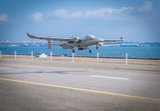
A T-7A Redhawk touches down at Vance Air Force Base, Oklahoma. (Photo: US Air Force)

Air Force One to land later

Regarding the VC-25B, it is intended to replace the current two VC-25A presidential aircraft with two commercial Boeing 747-8s modified to provide the US president with the same level of security and communications available in the White House.

Complex modifications and supply chain shortages caused the effort to be three years late. In September 2025, however, Boeing provided a revised schedule that would accelerate the deliveries, reducing the timeline by 21 months.

Still, the GAO warned that “other schedule risks remain, including the detailed designs for the aircraft interiors, fabrication of the wire bundles and rework to correct defects in structural modifications”.

Shephard reached out to the companies involved in all the programmes, but the vendors did not provide comments before this publication.

Boeing is the prime contractor for the B-52 CERP and RMP, MH-139A, T-7A and VC-25B while Northrop Grumman is the lead supplier of the LGM-35A Sentinel.

These capability and management problems are not an air domain exclusivity. The GAO stated that the Pentagon “continues to struggle to deliver technologies quickly and within budget”, and the overall average time to provide a capability to warfighters is now more than 12 years.

“Several MDAPs [major defence acquisition programmes] have not set new delivery dates or are delaying critical interim milestones,” the office added. “By keeping delivery dates static, these programmes raise questions about how realistic their estimates are. This means the 12-year average will likely increase in the future.”

In order to avoid postponements and additional costs, the GAO recommended the DoD ensure that acquisition policies for rapidly delivering capabilities start with mature technologies or develop associated immature technologies separately.

VC-25B [USA]

T-7A Red Hawk

T-38 Talon

MH-139

Flavia Camargos Pereira

Author

Flavia Camargos Pereira


Flavia Camargos Pereira is a North America editor at Shephard Media. She joined the company …

Read full bio

Share to

Linkedin